Career Guide
How to Write a Cover Letter That Gets You Hired (2026 Guide)
By Elara T · September 2026 · 12 min read
Most job seekers treat the cover letter as an afterthought — a generic paragraph copy-pasted from a template they found three years ago. That is a mistake. In a competitive job market, your cover letter is the single document that lets you explain why you want this specific role at this specific company. It is the difference between being another resume in the pile and being the candidate the hiring manager wants to meet.
The challenge is that most advice on cover letters is either too vague (“just be yourself”) or too rigid (“use this exact template”). Neither approach works. What works is understanding the structure that hiring managers expect, the content that makes them stop skimming and start reading, and the common mistakes that send your application straight to the rejection pile.
In this guide, I will walk you through the complete cover letter format — from the header to the closing — and give you actionable techniques for each section. Whether you are writing your first cover letter or rewriting one that is not getting results, this is the framework you need.
If you also need help with your resume, our AI resume generator can create an ATS-optimized resume in minutes. And if you want to practice your interview delivery, try our AI-powered mock interview tool.
Section 1: The Header
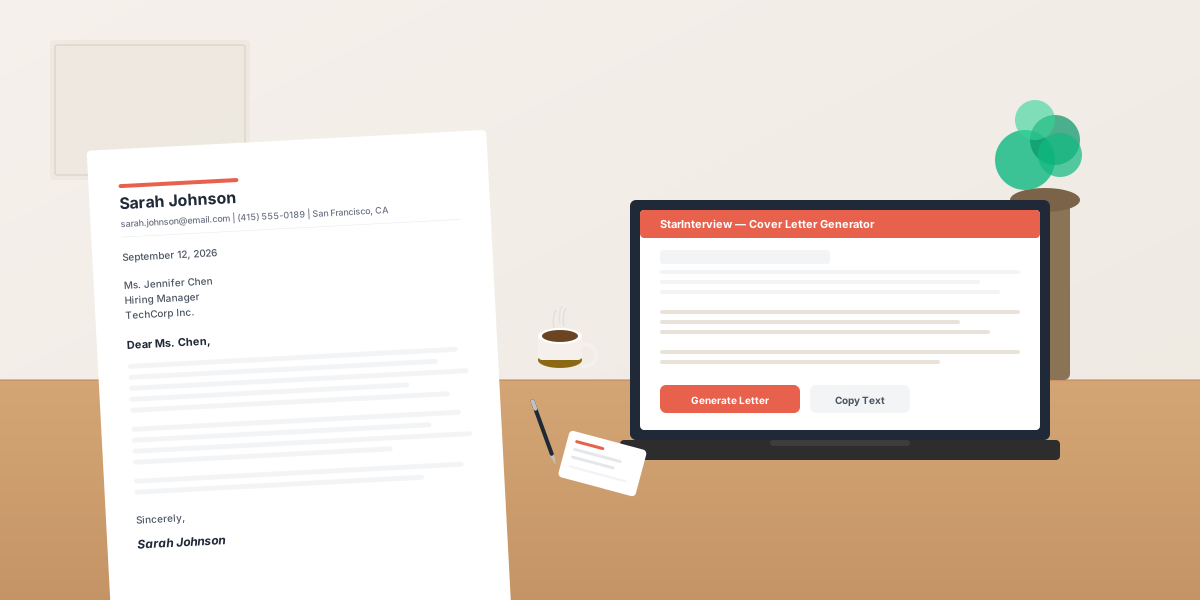
Your cover letter header should mirror your resume header for visual consistency. Include your full name, phone number, email address, city and state, and your LinkedIn URL. Below your contact information, add the date and the hiring manager's details: their name, title, company name, and company address.
A critical detail most candidates miss: find the hiring manager's name. Do not default to “Dear Hiring Manager” if you can avoid it. Check the job posting, the company's LinkedIn page, or even call the front desk and ask who is handling recruitment for the role. Addressing someone by name immediately signals effort and personalization.
If you truly cannot find a name, alternatives like “Dear [Department] Team” or “Dear [Company] Recruiting Team” are acceptable. Never use “To Whom It May Concern” — it is outdated and reads as lazy.
Section 2: The Opening Hook
Your opening sentence is the most important line in the entire letter. Hiring managers who screen hundreds of applications develop pattern recognition for generic openings — and they skip them immediately. If your first sentence could apply to any job at any company, it is not working hard enough.
Strong opening hooks do one of three things: they lead with a specific achievement, they reference something specific about the company, or they establish an immediate connection between your skills and the role. The goal is to make the reader think, “This person did their homework — I want to keep reading.”
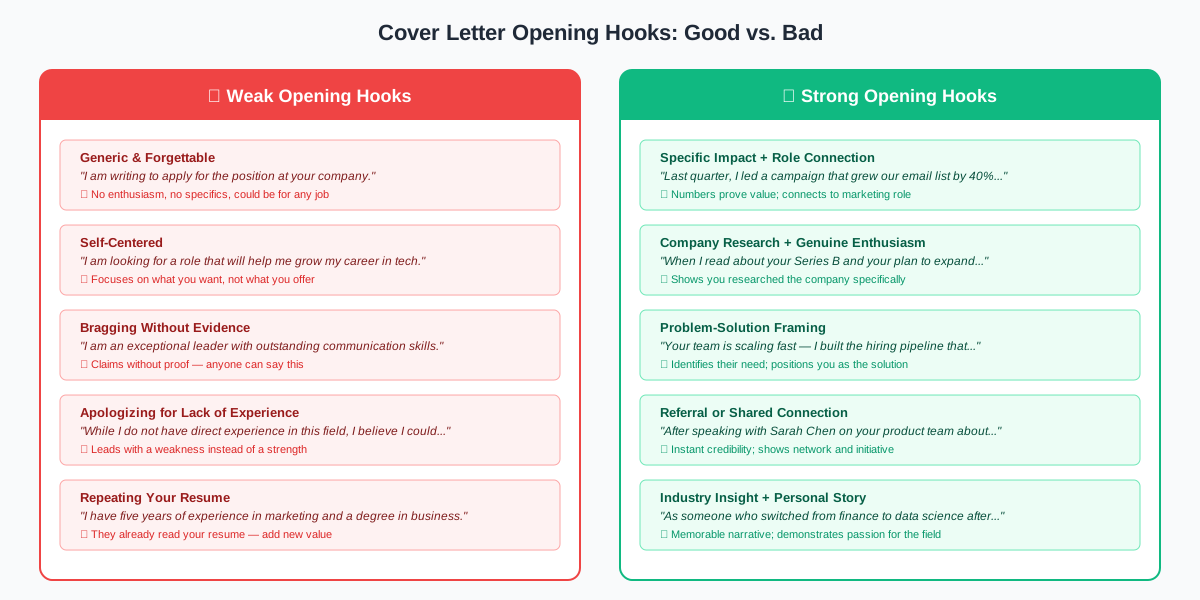
Here are four proven opening formulas you can adapt:
- The Achievement Lead: “Last quarter, I led a product launch that generated $1.2M in first-month revenue — and I want to bring that same execution energy to [Company]'s growth team.”
- The Company Connection: “When I read about [Company]'s expansion into the APAC market in your latest earnings call, I knew my five years of experience building regional sales teams in Southeast Asia could help accelerate that effort.”
- The Problem-Solution Frame: “Your customer support volume has tripled in the last year — I spent the past three years building the self-service platform at [Previous Company] that reduced ticket volume by 40%.”
- The Referral Drop: “After speaking with [Name] on your product team about the challenges of scaling your data pipeline, I became convinced that my background in distributed systems is a strong fit for this role.”
Section 3: The Body Paragraphs
The body of your cover letter is where you provide evidence. You need two paragraphs: one that demonstrates your qualifications and one that shows your fit with the company and role.
Paragraph 1: Prove Your Value
Pick two or three achievements from your career that directly relate to the job description. Do not list responsibilities — describe outcomes. Use the formula: Situation → Action → Result. Quantify wherever possible.
Weak: “I have experience managing marketing campaigns.”
Strong: “At [Company], I restructured our email marketing strategy around behavioral segmentation, which increased click-through rates by 62% and drove an additional $800K in annual recurring revenue from existing customers.”
If you are an experienced professional, focus on your most recent and most relevant accomplishments. If you are a recent graduate, draw from internships, academic projects, or volunteer leadership roles. The principle is the same: specific evidence beats vague claims every time.
Paragraph 2: Show Company Fit
This paragraph is what separates a good cover letter from a great one. It demonstrates that you are not just qualified — you are the right qualified person for this team. Reference the company's mission, a recent product launch, a challenge mentioned in the job posting, or a value the company publicly champions. Then connect it to your own experience or motivation.
For example: “Your commitment to making financial tools accessible to underbanked communities resonates with my own background — I spent two years volunteering with a nonprofit that provided financial literacy workshops in rural areas, and I have seen firsthand how the right product can change lives.” This kind of specificity is impossible to fake, and hiring managers can tell the difference.

Section 4: The Closing
Your closing should be confident, concise, and forward-looking. Restate your interest in the role, express enthusiasm about the opportunity to discuss your qualifications, and include a clear call to action. Avoid weak closings like “I hope to hear from you” — instead, say something like, “I would welcome the opportunity to discuss how my experience with [specific skill] can contribute to [Company]'s [specific goal].”
Sign off with “Sincerely” or “Best regards” followed by your full name. If submitting a physical letter, leave space for your signature. For digital submissions, a typed name is sufficient.
5 Cover Letter Mistakes That Get You Rejected
Knowing the right format is essential, but avoiding the wrong habits matters just as much. Here are the five most common mistakes that cost candidates interviews.
A cover letter is not your autobiography. Every paragraph should answer the reader's unspoken question: “What can this person do for us?” Frame your experience in terms of the value you bring to the company, not the value the job brings to your career.
Your resume already lists your jobs and responsibilities. The cover letter adds context, personality, and narrative. If someone could get the same information from your resume alone, the paragraph is wasted space.
Phrases like “I am a team player,” “I am passionate about excellence,” and “I think outside the box” are filler. Replace them with specific examples that demonstrate the quality you are claiming. Show, do not tell.
A single typo in a cover letter can disqualify you. It signals carelessness in the one document where you had unlimited time to get it right. Read your letter out loud, run it through a grammar checker, and ask someone else to review it before you submit.
If your cover letter exceeds one page, edit it down. Hiring managers do not have time for long letters, and length often signals a lack of focus. Every sentence should either prove your qualifications or demonstrate your fit. If it does neither, cut it.
Tailoring Your Cover Letter for Different Situations
The core structure stays the same, but the emphasis shifts depending on your situation. Here is how to adapt.
Career Changers
Lead with transferable skills rather than job titles. In your body paragraph, draw explicit connections between what you have done and what the role requires. For example, if you are moving from teaching to corporate training, emphasize your curriculum design experience, your ability to engage diverse audiences, and your data-driven approach to measuring learning outcomes. Your cover letter is the place to make the case that your background is an asset, not a liability.
Returning to the Workforce
If you have a gap in your resume, the cover letter is your chance to address it briefly and positively. You do not need to over-explain — one sentence is enough. For example: “After taking time to care for a family member, I am eager to bring my eight years of operations experience back to a fast-growing team.” Then immediately pivot to your qualifications and what you bring to the table.
Recent Graduates
You have less professional experience, so lean into academic projects, internships, leadership roles, and relevant coursework. Show enthusiasm and a willingness to learn. Demonstrate that you have researched the company and understand what the role involves. If you are using a resume builder designed for entry-level candidates, make sure your cover letter complements — not duplicates — what the resume says.
How to Use AI to Write a Better Cover Letter
AI tools have transformed the cover letter writing process. Instead of staring at a blank page, you can input the job description and your background, and the AI will generate a structured draft in seconds. But the key word is draft. Here is the workflow I recommend.
Step 1: Generate a structure. Use an AI tool to create a first draft based on the job posting. Our AI cover letter generator analyzes the job description and matches your experience to the role requirements, producing a tailored draft that hits the right keywords and structure.
Step 2: Add your voice. Replace generic phrases with your own language. Add specific numbers, project names, and personal details that only you know. This is what makes the letter sound authentic rather than robotic.
Step 3: Customize the company section. Research the company's recent news, mission statement, and culture. Write the “why this company” paragraph from scratch — this is the section that benefits most from genuine human insight.
Step 4: Proofread and refine. Read the letter out loud to catch awkward phrasing. Check that every claim in the letter is backed by something on your resume. Ensure the tone matches the company culture — a startup cover letter should read differently from one to a law firm.
Many candidates also use a professional resume template alongside their cover letter to ensure visual consistency across both documents. When your resume and cover letter share the same header, font, and style, it creates a polished, cohesive application package.
Write Your Cover Letter in Minutes With AI
Paste a job description, add your experience, and get a tailored cover letter draft you can personalize and send. Try StarInterview's cover letter generator — free.
Generate Your Cover Letter →Cover Letter Checklist Before You Hit Send
Before submitting your application, run through this final checklist:
- The letter is addressed to a specific person (if possible).
- The opening sentence mentions a specific achievement, company detail, or connection.
- The body contains at least two quantified accomplishments relevant to the role.
- You have explained why you want to work at this company, not just any company.
- The closing includes a clear, confident call to action.
- The letter is under one page (250–400 words).
- You have proofread for typos, grammar, and the correct company name.
- Your contact information matches your resume exactly.
If you can check every box, your cover letter is ready. Pair it with a strong, ATS-optimized resume — you can use our AI resume generator to build one in minutes — and you will have a complete application package that stands out.
Frequently Asked Questions
How long should a cover letter be?
A cover letter should be 250 to 400 words — roughly three to four paragraphs that fit on a single page. Hiring managers spend an average of seven seconds scanning a cover letter before deciding whether to keep reading. Anything longer risks losing their attention. Focus on quality over quantity: every sentence should earn its place by connecting your experience to the role or demonstrating your value.
Do I really need a cover letter if the application does not require one?
Yes, whenever possible. A cover letter is your only chance to show personality, explain career transitions, and address specific needs the company has. Even when a job posting says a cover letter is optional, submitting one signals genuine interest and effort. According to a 2025 ResumeGo study, candidates who included a tailored cover letter received 50% more callbacks than those who submitted a resume alone.
Should I use the same cover letter for every application?
No. Generic cover letters are easy to spot and almost always get discarded. You should customize at least the opening paragraph and the body for each application. The good news is that you can create a strong base template and then adjust the details — the company name, the specific role requirements, and the relevant accomplishments — for each job. This approach balances efficiency with the personalization hiring managers expect.
What if I am changing careers and lack direct experience?
A career change cover letter is actually one of the best use cases for this document. Your resume may not tell the full story, but a cover letter lets you explain the connection between your past experience and the new role. Focus on transferable skills — project management, data analysis, stakeholder communication, leadership — and frame your career change as a deliberate, motivated choice rather than a gap. Show that you have done the research and invested in learning the new field.
Can AI help me write a better cover letter?
Absolutely. AI tools can analyze the job description, identify the most relevant keywords and skills, and help you structure your letter for maximum impact. The key is to use AI as a starting point and then inject your own voice, specific examples, and genuine enthusiasm. A completely AI-generated letter will sound generic; a letter where AI handles the structure while you add the substance will sound polished and authentic. Tools like StarInterview's cover letter generator are designed for exactly this workflow.
Related Guides
- AI Resume Generator: Build an ATS-Optimized Resume in Minutes
- Professional Resume Templates for Every Industry
- How AI Can Write a Better Resume Than You (And Why That's OK)
- How to Answer “Tell Me About Yourself” in a Job Interview
- Behavioral Interview Questions and Answers: STAR Method Guide
- Common Interview Mistakes That Cost You the Job
- Practice Mock Interviews With AI Feedback