Case Interview Questions for Tech Companies: 5 Mini-Case Types and How to Answer Each (2026)
The direct answer: case interview questions at tech companies are usually 5–10 minute mini-cases — product, metric, trade-off, estimation, or incident — not 45-minute consulting builds. Interviewers score how you clarify, name a structure out loud, and land a decision, not a magic number. Below: the five types with the exact opening move for each, plus drills to practice alone or with a partner.
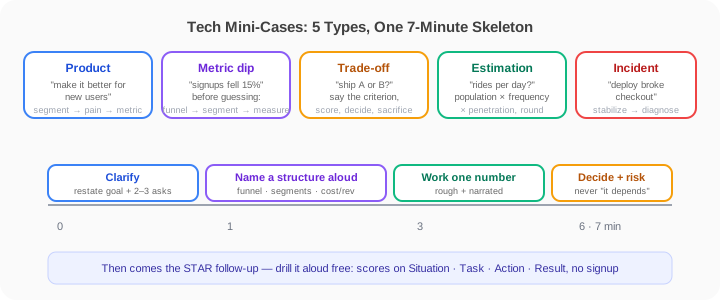
The 5 Mini-Case Types Tech Companies Actually Ask
Searching for “case interview questions” mostly returns consulting material — profitability trees and market sizing with hidden charts. Big-tech and startup interviews run a different format: short situational prompts, no data sheets, no interviewer holding secret information. The trade-off is that they grade your verbal structure in real time. Here is each type and the first move that works:
Product improvement
"Pick a product you love. How would you make it better for a new user group?"
Opening move: Pick a user segment and a pain, then one metric that proves it. 5 quick ideas, rank by impact ÷ effort, defend #1.
Typical for: PM, product engineer, design
Metric diagnosis
"Daily signups dropped 15% this week. What do you check?"
Opening move: Split the funnel (acquire → activate → retain), then segment (platform, geo, cohort, source) before guessing causes. Check measurement and release changes first — cheapest answers.
Typical for: Data, growth, analytics
Trade-off / prioritization
"You can ship one of two features this quarter. How do you choose?"
Opening move: State the decision criterion out loud (revenue, retention, strategic fit), score both options roughly on it, decide, and name what you would sacrifice.
Typical for: PM, eng lead, startup generalist
Estimation
"How many rides does a ride-share app take in your city per day?"
Opening move: Anchor with one population, one frequency, one penetration rate; round everything; sanity-check against a known number at the end.
Typical for: Data, strategy, eng
Incident / operational
"A deploy broke checkout for 20 minutes. Walk me through your response."
Opening move: Stabilize first (roll back), then communicate, then diagnose, then prevent (postmortem, test gap). They are listening for sequencing, not heroics.
Typical for: SWE, SRE, devops
One Answer Skeleton for All Five
- • Minute 1 — Clarify: restate the goal in one sentence, ask 2–3 scoping questions (who is the user, what window, what constraint). Solving before clarifying is the #1 fail.
- • Minutes 2–3 — Name a structure: say the split you will use out loud — funnel, segments, cost/revenue, severity tiers. A mediocre analysis with a clean structure outscores brilliant guessing said incoherently.
- • Minutes 4–6 — Work one number: rough math beats no math; round aggressively and narrate each step. Do not hunt for the “right” figure — tech interviewers are not hiding one.
- • Minute 7 — Decide and flag a risk: end with a recommendation, one trade-off you accept, and what you would measure next. No trailing-off into “it depends.”
Then they pivot: “tell me about a time you made a decision with incomplete data.” That follow-up is pure behavioral — answer it with the STAR method and rehearse it aloud on the free scored practice tool. Role-specific deep dives: software engineer, product manager, data analyst.
The 7 Questions, Answered
Do tech companies ask case interview questions?
Yes — but a shorter form. Product, data, PM, engineering, and strategy roles at tech companies typically get a 5–10 minute situational mini-case ("metrics dropped 20% — what do you do?") instead of the 45-minute consulting case with charts. Fit interviews for MBA-hiring rotations blend both. Expect one to three of them per loop, plus behavioral follow-ups on your answer.
How do you answer a case interview question at a tech company?
Three moves: clarify (restate the goal, ask 2–3 scoping questions), structure (name your framework out loud before solving — segments, funnel, cost/revenue), then compute and conclude (one rough number, a recommendation, one risk). Interviewers score the shape of your thinking, not a magic answer. Say your steps aloud — silence reads as no structure.
What are the most common tech company case questions?
Five families repeat across interviews: product improvement ("make our app better for X users"), metric diagnosis ("signups fell 15% — why?"), trade-off ("ship feature A or B first?"), estimation ("how many people use this daily?"), and incident ("a rollout broke checkout — walk through it"). Each maps to a fixed opening move you can drill.
How to practice case interviews alone?
Three drills that work without a partner: talk through one mini-case out loud against a 7-minute timer and record it; write the opening three sentences (goal, scoping question, framework name) for ten questions from a bank; and rehearse the STAR follow-ups they always ask ("tell me about a time you used data…"). The gap in solo practice is honest feedback — a scorer closes it.
How to practice case interviews with a partner?
Swap roles in 20-minute blocks: one reads the prompt cold, the other thinks aloud while the partner marks three things — did they clarify before solving, name a structure, end with a recommendation? Rotate. Partners who know nothing about cases make the best interviewers because they only judge clarity, not insider knowledge.
What is the best way to practice case interviews?
Short, scored reps. One drilled mini-case you re-run until the answer is crisp beats five read-throughs. Cycle: solve aloud → get feedback on structure and conclusion → re-solve. Add real pressure by switching to your interview language and by answering the behavioral follow-ups with STAR — most candidates fail the follow-up, not the case.
How is a tech company case different from a consulting case?
Consulting cases are long, data-heavy, and interviewer-led with hidden info. Tech mini-cases are short (5–10 minutes), rarely hand you charts, and reward product judgment, metric literacy, and a decision under ambiguity. Prepare differently: drill clean verbal structure here; drill chart math and frameworks like profitability trees there.
Honest Limits of This Page
We do not fabricate company-specific cases: prompts above are the common families reported across interview experience posts, not leaked questions — firms rotate them anyway, so drill the skeleton, not the bank. Our free tool scores your behavioral follow-ups (S/T/A/R per dimension on spoken answers); for the mini-case itself it gives you the timer, the outline, and an answer generator draft to personalize — self-check the structure against the skeleton above, or compare human mock options in our mock platform comparison. If your target is consulting proper (MBB full cases with charts), start at consulting interview prep instead.