STAR Method Practice: Questions, Sample Answers & a 10-Minute Drill
The shortest answer: STAR practice means drilling five or six personal stories until you can deliver each one in 90 seconds — Situation and Task brief, Action detailed, Result quantified — and then getting feedback on whether you actually did that. Reading guides doesn't build the skill; timed repetition with scoring does.
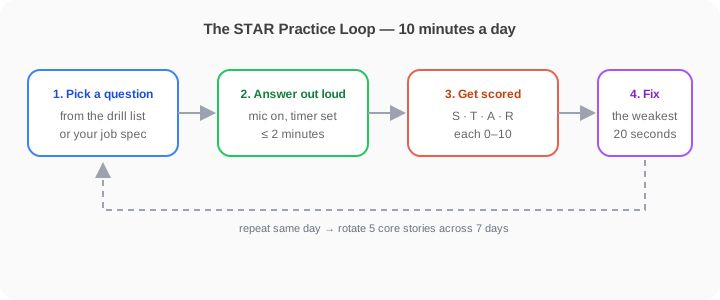
The 10-Minute Daily STAR Drill
Most people "practice" by re-reading sample answers. That's recognition, not recall — it feels productive but doesn't survive interview pressure. Replace it with this loop:
- 1Pick one question from the list below (or paste your own job description question).
- 2Answer it out loud in under 2 minutes — no notes. Talking, not typing, is what transfers to a real interview.
- 3Get feedback on each dimension separately: was the Situation context-only? Did the Task state your responsibility? Was the Action specific to you? Did the Result have a number?
- 4Rewrite the weakest 20 seconds and deliver the story again the same day.
- 5Rotate through 5 core stories over 7 days. By day 7 you have a rehearsed, scored set that covers 80% of behavioral questions.
10 STAR Practice Questions (Sorted by Frequency)
These are the behavioral question stems interviewers actually use — the same ones behind "star method practice questions" and "star method sample questions and answers" searches. Each one takes a STAR story; the trick is reusing 5-6 stories across many of them.
- Q1Tell me about a time you faced an unexpected challenge at work.
- Q2Describe a situation where you had to meet a tight deadline.
- Q3Give an example of a goal you reached and tell me how you achieved it.
- Q4Describe a time you disagreed with a decision at work.
- Q5Tell me about a time you failed. What did you learn?
- Q6Share an example of working with a difficult coworker.
- Q7Describe a time you went above and beyond for a customer or stakeholder.
- Q8Tell me about a time you had to learn something quickly.
- Q9Give an example of a time you led a project without formal authority.
- Q10Describe a situation where you had to juggle multiple priorities.
Want model answers? See STAR method example answers with full breakdowns, or what S-T-A-R stands for if you're brand new.
What "Good" Looks Like: A Scored Sample Answer
Here's how StarInterview's AI grades a practice answer — each STAR dimension is scored separately, which is the part you can't get from reading static samples:
Q1: "Tell me about a time you faced an unexpected challenge." — candidate answer (excerpt):
"Our payment vendor changed their API with two weeks' notice right before Black Friday. I owned the migration — audited our call sites, negotiated a 10-day extension with the vendor's support engineer, paired with a junior dev to rewrite the webhook handler, and added regression tests. We launched on time; checkout error rate actually dropped 12% because we fixed a latent bug during the rewrite."
- Situation (8): stakes and deadline stated — good. Lost a point for not saying team size, which sets context for the ask.
- Task (9): "I owned the migration" — explicit ownership, exactly what this dimension checks. Most answers bury it in "we".
- Action (9): three concrete, personal moves (negotiated, paired, rewrote) instead of vague process talk.
- Result (10): quantified (12%), with a bonus outcome the interviewer didn't ask for. This is the dimension candidates most often leave blank.
The feedback loop that produces scores like this is free and needs no account — open the practice tool, hit the mic, and you get dimension scores in seconds. It also accepts answers in 7 languages, which matters if English isn't your first language and you want to structure the story before polishing the phrasing.
Why Practice Answers Beat Reading Answers
- Interviews are timed recall, not reading comprehension
You'll get 2 minutes per question under pressure. Only spoken rehearsal builds retrieval speed. Sample answers teach shape; drilling builds the muscle.
- Your weak dimension is invisible on paper
Most people can self-check Structure but can't self-check Result quantification — that's exactly what an external scorer catches.
- Stories decay without reuse
A story you delivered once three weeks ago will come out differently under stress. Cycle your 5 core stories through short drills weekly until interview day.
- Nervous pacing changes everything
Practice out loud with a timer once and you'll discover your '90-second' story is actually 3 minutes. Trimming is the practice.
Practice Mistakes That Waste Your Reps
- ✕Practicing all 6 dimensions of perfectionism — Drill one dimension at a time. Today make every Result numeric; tomorrow make every Action start with 'I', not 'we'.
- ✕Memorizing word-for-word — Memorize the beats (S→T→A→R), not the script. Word memorization collapses when an interviewer interrupts — beat memorization survives.
- ✕Only practicing your favorite story — Interviewers probe the story you're least ready for. Rotate all 5 core stories per session.
- ✕Silent practice — Mouthed answers skip the breathing, pacing, and mic-timing problems that actual speaking exposes.
Frequently Asked Questions
How many STAR practice questions do I need to prepare?
Not one per question — one per story. Five to six strong, flexible stories cover the vast majority of behavioral questions, because question stems cluster into challenge, conflict, failure, leadership, and deadline themes. Practice each story from 3-4 different question angles.
How long should a STAR answer be when practicing?
90 seconds to 2 minutes spoken. In practice drills, time yourself: under 60 seconds usually means the Action is vague, and over 3 minutes means Situation and Task are eating the interview's attention.
Can I practice the STAR method for free without signing up?
Yes — that's exactly what StarInterview is built for. The practice tool gives instant STAR scoring on all four dimensions with no account required. Type or use voice input, and switch between 7 languages if you're preparing in a non-native language.
What's the difference between STAR technique practice and just rehearsing answers?
STAR practice has a rubric: each dimension (Situation, Task, Action, Result) is checked separately. Generic rehearsal only checks fluency. You can be fluent and still fail the Result dimension, which scorers catch instantly.
How many days before an interview should I start STAR practice?
Seven is the realistic minimum for 5 stories: 2 days building story beats, 3 days scored drills, 2 days random-order recall under pressure. One day is enough to polish stories you already have.