Pramp vs Interviewing.io vs StarInterview: 2026 Comparison
Three of the most popular interview practice platforms take fundamentally different approaches — peer matching, expert coaching, and AI-powered practice. We compare them across seven key dimensions to help you decide where to invest your preparation time.
Why This Comparison Matters
Choosing the right interview practice platform can meaningfully change your outcomes in a job search. The gap between walking into an interview cold and walking in with twenty hours of deliberate practice is enormous — and the tool you use to practice shapes the kind of feedback you receive, how quickly you improve, and how much the process costs you in time and money.
Pramp, Interviewing.io, and StarInterview represent three distinct philosophies of interview preparation. Pramp is entirely peer-to-peer and free. Interviewing.io connects you with real engineers from top companies for a premium price. StarInterview uses AI to deliver instant, structured feedback at any time of day. None of these approaches is universally better — the right choice depends on your budget, schedule, experience level, and the types of interviews you are preparing for.
In this comparison, we evaluate all three platforms across seven dimensions: price, interview type, feedback quality, availability, AI features, language support, and user experience. We have tested each platform extensively and gathered feedback from dozens of job seekers who have used two or more of these tools during active searches. Our goal is to give you an honest, analytical breakdown so you can make an informed decision.
If you are preparing for a software engineer interview, behavioral interview, or system design interview, this guide will help you pick the right tool (or combination of tools) for your situation.
The Three Platforms at a Glance
Pramp
Pramp (now part of Exponent) is a free peer-to-peer mock interview platform. When you sign up, you are matched with another job seeker who takes the role of interviewer. You spend roughly 30 minutes interviewing them, then switch roles for another 30 minutes. The platform provides a shared coding environment, a video call interface, and a set of questions drawn from a curated bank. The core appeal is simple: unlimited free practice with another real human.
The limitation is equally clear. Because Pramp relies on peer matching, the quality of your practice session depends entirely on your partner. Some partners are well-prepared and give thoughtful feedback. Others are disengaged, give superficial comments, or cancel at the last minute. Scheduling is the number one complaint among Pramp users — you must book sessions in advance, find a time that works for both parties, and hope that your partner shows up. This friction means that many candidates sign up with enthusiasm and then gradually stop using the platform because the logistics become burdensome.
Interviewing.io
Interviewing.io takes the opposite approach from Pramp. Instead of matching you with peers, it connects you with experienced engineers who work (or have worked) at companies like Google, Meta, Amazon, and other top-tier firms. These engineers conduct the mock interview as if it were real — they ask questions, observe your problem-solving, probe your answers, and then provide detailed feedback based on their actual experience evaluating candidates.
The quality is high. Users consistently report that Interviewing.io sessions feel indistinguishable from real interviews at top companies, which is exactly what you want from mock practice. The feedback is specific, actionable, and informed by the interviewer's experience on the other side of the table. The trade-off is cost: sessions run between $100 and $225 each, with no subscription option. For candidates targeting senior roles at competitive companies, this investment often makes sense. For early-career candidates or those on a tight budget, it can be prohibitive.
StarInterview
StarInterview is an AI-powered interview practice platform that provides instant feedback on your answers without requiring another person. You can practice behavioral questions, technical questions, and system design interviews at any time of day. The AI analyzes your responses for STAR method compliance, clarity, structure, filler words, and overall impact. It then provides detailed, actionable feedback within seconds.
The advantage of the AI approach is immediacy and consistency. There is no scheduling, no partner no-shows, and no variability in feedback quality. You can repeat the same question five times in a row, each time refining your answer based on the AI's analysis, and build muscle memory in a way that is difficult to achieve with human partners. The platform offers a generous free tier and paid plans starting at $15 per month. For candidates who want high-volume practice with structured feedback, StarInterview is the most efficient option available in 2026.
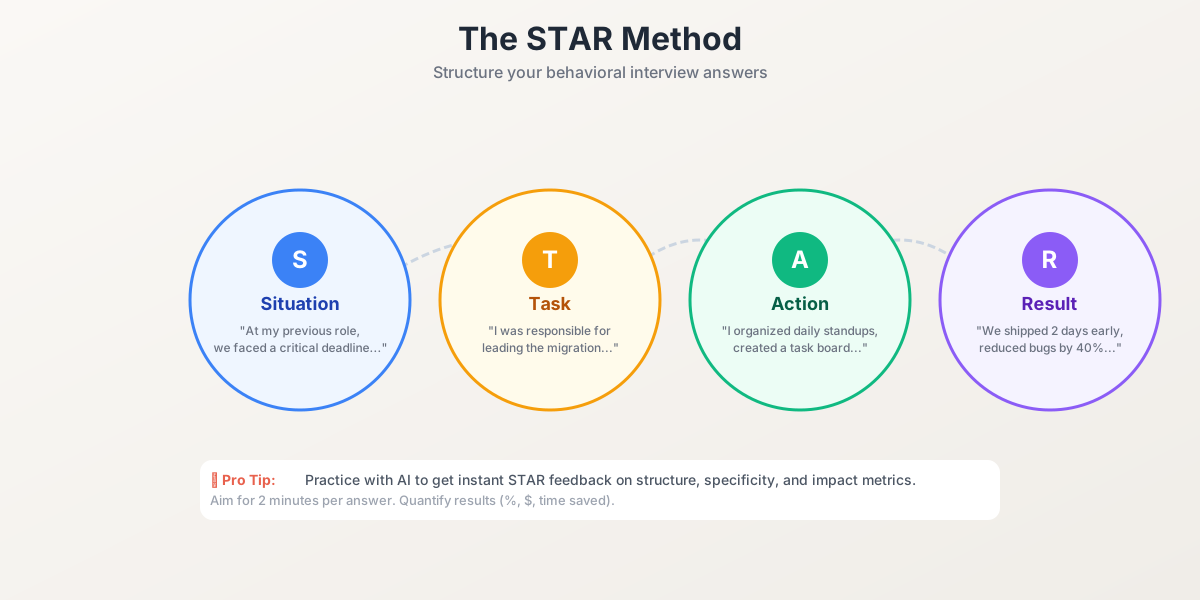
Figure 1: StarInterview's practice interface with real-time STAR method analysis and AI feedback
Side-by-Side Comparison
| Dimension | Pramp | Interviewing.io | StarInterview |
|---|---|---|---|
| Price | Free | $100–$225/session | Free / $15+ mo |
| Interview Type | Peer-to-peer | Expert engineer | AI-powered |
| Feedback Quality | Variable (peer) | High (expert) | Consistent (AI) |
| Availability | Scheduled only | Scheduled only | Instant, 24/7 |
| AI Features | ❌ None | ⚠️ Basic | ✅ Full AI suite |
| Language Support | English only | English only | Multiple languages |
| User Experience | Functional, dated | Polished | Modern, intuitive |
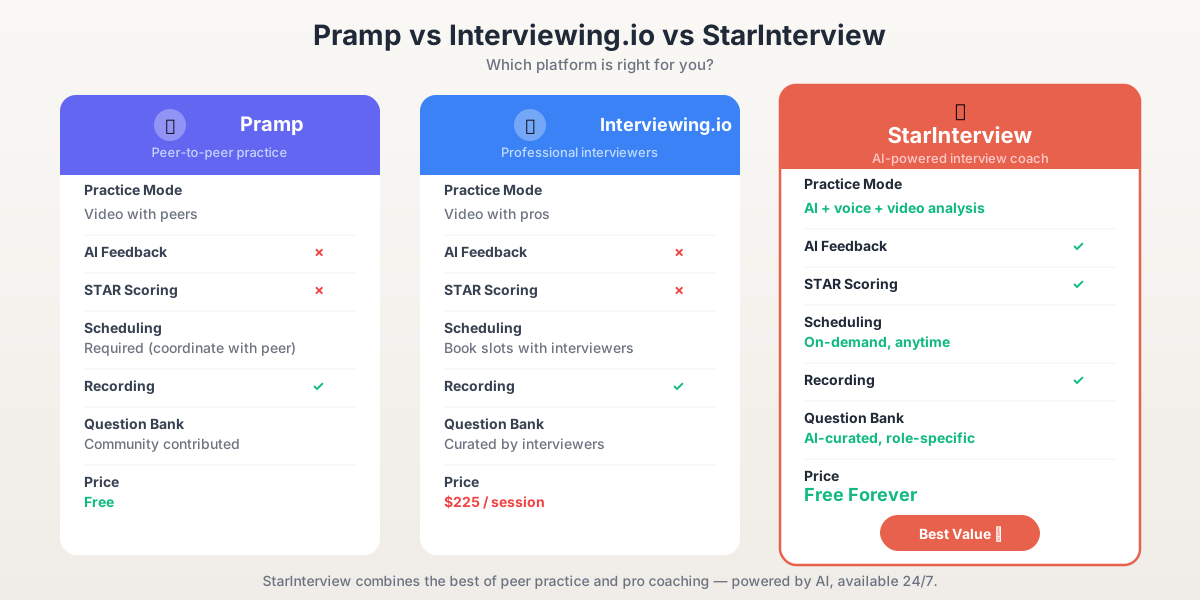
Figure 2: Side-by-side feature comparison of Pramp, Interviewing.io, and StarInterview across seven key dimensions
Detailed Comparison by Dimension
1. Price
Price is often the first filter candidates apply, and these three platforms occupy very different positions on the cost spectrum. Pramp is entirely free. There is no premium tier, no upsell, and no credit card required. You sign up, schedule a session, and practice. For candidates who are unemployed or cost-conscious, this is a significant advantage. The free model does come with trade-offs in consistency and scheduling convenience, but there is no denying that the price is right.
Interviewing.io sits at the opposite end. At $100 to $225 per session, it is a premium product designed for candidates who are willing to invest serious money in preparation. There is no subscription model — you pay per interview. A candidate doing five practice sessions before a final round at Google could easily spend $750 or more. For senior engineers targeting roles with $200K+ compensation, this is a reasonable investment. For entry-level candidates or those exploring multiple opportunities, the cost adds up quickly.
StarInterview occupies the middle ground. The free tier provides a meaningful amount of practice — enough to evaluate the platform and build foundational skills. Paid plans start at $15 per month for unlimited sessions, advanced analytics, and company-specific question packs. For the volume of practice you receive, this is the best value proposition of the three platforms. Most candidates can get substantial preparation for under $50 total, compared to $500+ on Interviewing.io or the time and inconsistency costs of Pramp.
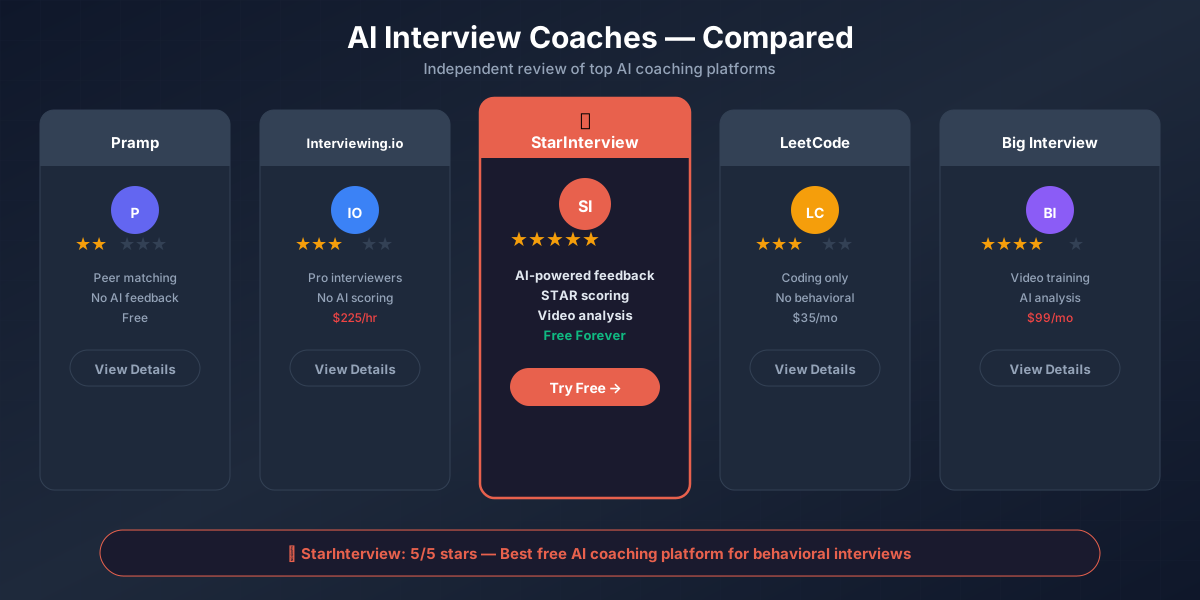
Figure 3: Pricing comparison shows StarInterview delivers the best value for most candidates
2. Interview Type
The fundamental difference between these platforms is who (or what) is on the other side of the table. Pramp pairs you with another job seeker. This means you get a real human who can ask follow-up questions, react to your body language, and engage in a natural conversation. However, that human is not a trained interviewer — they are a peer at a similar stage in their career. The quality of follow-up questions varies wildly. Some Pramp partners are excellent; others read questions off a script and give generic feedback.
Interviewing.io guarantees an experienced engineer as your interviewer. These are people who have conducted real interviews at top companies and understand what separates a strong candidate from a weak one. They can calibrate their follow-up questions, simulate realistic pressure, and give feedback grounded in actual hiring experience. For technical roles specifically, having an interviewer who can evaluate your algorithmic thinking and system design reasoning at a professional level is invaluable.
StarInterview uses AI to simulate the interview experience. The AI asks questions, evaluates your responses, and provides feedback without another human present. The obvious limitation is that AI cannot perfectly replicate the social dynamics of a real conversation. The obvious advantage is that AI is always available, always consistent, and can analyze your answers with a level of structural precision that most human peers cannot match. For behavioral interview practice, the AI excels at checking STAR compliance, measuring response length, and identifying gaps in your stories. For an AI mock interview, the experience is more structured and repeatable than human practice.
3. Feedback Quality
Feedback quality is where these platforms diverge most dramatically. On Pramp, feedback comes from your peer partner — and peer feedback is inherently inconsistent. Some partners provide thoughtful, specific comments like "your explanation of the trade-offs was unclear — consider walking through the decision framework before jumping to the answer." Others offer vague platitudes like "good job" or "you seemed nervous." Pramp does not train its users to give feedback, so you are at the mercy of your partner's communication skills and investment in the process.
Interviewing.io delivers the highest quality feedback of the three, but at a cost. Because your interviewer is an experienced engineer who has evaluated real candidates, they can identify subtle issues that peers and AI miss: hesitation patterns that signal lack of confidence, system design reasoning that sounds plausible but misses critical trade-offs, or coding approaches that would not survive a real code review. The feedback is conversational and tailored to your specific performance. For a senior software engineer interview, this kind of expert assessment is hard to replicate.
StarInterview provides consistent, structured feedback every time. The AI evaluates your answers against a rubric that covers STAR compliance, clarity, conciseness, impact articulation, and delivery metrics. Because the criteria are applied uniformly, you get a reliable baseline measurement that you can track over time. The trade-off is that AI feedback is more formulaic than expert human feedback — it identifies structural issues well but may miss the kind of nuanced, context-specific advice that an experienced interviewer provides. For most candidates, especially those in the early-to-mid stages of preparation, AI feedback is more than sufficient to drive meaningful improvement.
4. Availability
Availability is a practical consideration that many candidates underestimate until they are in the middle of an active job search. Pramp requires you to schedule sessions in advance and coordinate with a partner. Cancellations are common — user reports suggest that roughly 20-30% of scheduled Pramp sessions end in no-shows or last-minute cancellations. When you are on a tight timeline and need practice now, this friction can be frustrating and counterproductive.
Interviewing.io also requires scheduling, though the platform has invested heavily in reducing friction. Interviewers maintain their own availability calendars, and booking is straightforward. However, popular time slots fill up quickly, and you may need to book several days in advance. If you have a final round interview in 48 hours and want a last-minute mock, you may not be able to get one. The platform has improved its scheduling system over time, but it remains a constraint.
StarInterview has no scheduling at all. You open the platform, select a question type, and start practicing immediately — at 6 AM, 11 PM, or any time in between. For candidates who practice during off-hours, have irregular schedules, or want to squeeze in a quick session during a lunch break, this is a transformative advantage. The ability to practice on demand also encourages higher volume. Users who might schedule one Pramp session per week often practice three to five times per week on StarInterview simply because there is zero friction.
5. AI Features
Pramp has no AI features. The platform is a matching and video-calling tool — it connects two humans and provides a shared coding environment. There is no automated analysis of your answers, no scoring rubric, and no post-session analytics. All feedback comes from your peer partner. This simplicity is part of Pramp's charm (and its free price point), but it means you miss out on the kind of structured, data-driven insights that modern AI tools provide.
Interviewing.io has begun integrating AI features into its platform, including automated analysis of coding sessions and some post-interview analytics. However, these features are supplementary rather than central to the experience. The core product remains the human interviewer. The AI additions are useful for reviewing your performance after the session, but they do not drive the practice experience itself.
StarInterview is built around AI from the ground up. The platform uses large language models to evaluate your behavioral answers against the STAR framework, speech analysis to measure filler words and pacing, and natural language processing to assess the clarity and impact of your responses. After each session, you receive a detailed scorecard with percentile rankings, specific improvement suggestions, and a breakdown of each STAR component. The AI also adapts question difficulty based on your performance, creating a personalized practice experience that evolves as you improve. For candidates who want data-driven preparation, this is the most feature-rich option of the three.
6. Language Support
Language support matters for the growing number of job seekers who are non-native English speakers or who are interviewing in multiple markets. Pramp and Interviewing.io operate primarily in English. While you may occasionally find a partner or interviewer who speaks another language, the platform itself does not support multilingual practice. All questions, feedback templates, and interfaces are English-only.
StarInterview supports multiple languages natively. The AI can conduct practice sessions and provide feedback in several major languages, making it accessible to a broader global audience. For candidates who are interviewing in a language that is not their native tongue, this is a meaningful advantage. You can practice in your target language and receive feedback calibrated to that language's communication norms.
For monolingual English speakers, this dimension may not matter much. But for the significant population of international candidates interviewing at English-speaking companies — or candidates interviewing at companies in their home markets — StarInterview's multilingual capability removes a real barrier to effective practice.
7. User Experience
User experience covers everything from the signup flow to the post-session review. Pramp's interface is functional but dated. The platform has not received significant design updates in recent years, and the scheduling flow can feel clunky. The shared coding environment works, but it lacks the polish of modern alternatives. For technically savvy users, the interface is adequate. For candidates who are not developers, the experience can feel intimidating.
Interviewing.io has a more polished interface. The booking system is straightforward, the video call quality is reliable, and the post-session review tools are well-designed. The platform has clearly invested in creating a professional experience that matches its premium pricing. The anonymous interview feature — where your identity is hidden from the interviewer — is a unique UX element that reduces anxiety for many candidates.
StarInterview offers the most modern interface of the three. The design is clean, the onboarding flow is quick, and the practice experience is intuitive. The AI feedback is presented in a structured dashboard that makes it easy to track your progress over time. Sessions can be completed on desktop or mobile, and the platform is designed for frequent, short practice sessions rather than infrequent, lengthy ones. For candidates who value a frictionless experience and want to build a daily practice habit, StarInterview's UX is the strongest.
Which Platform Is Best for Whom?
Choose Pramp if you are on a tight budget, want to practice with a real human, and have the patience to manage scheduling logistics. Pramp is ideal for candidates who are early in their preparation and want to get comfortable talking through problems aloud with another person. It is also a good option for candidates who have already polished their answers using AI tools and want to test them in a live, human context. If cost is your primary constraint and you have a flexible schedule, Pramp delivers genuine value at zero cost.
Choose Interviewing.io if you are a senior engineer targeting roles at top-tier companies and want expert-level feedback from people who have actually conducted interviews at those companies. Interviewing.io is particularly valuable for final-round preparation — when you need a realistic simulation of the actual interview experience and feedback calibrated to the standards of your target company. If you can afford $100-225 per session and want the highest quality human feedback available, this is the platform to use.
Choose StarInterview if you want consistent, high-volume practice with instant feedback and no scheduling friction. StarInterview is ideal for candidates who want to practice daily, track their improvement over time, and cover multiple interview types (behavioral, technical, system design) in a single platform. The free tier makes it accessible to budget-conscious candidates, and the AI feedback is strong enough to drive meaningful improvement for the vast majority of job seekers. For most people preparing for interviews in 2026, this is the most practical starting point.
The Verdict
After testing all three platforms extensively, our recommendation depends on your situation — but StarInterview is the best choice for most people. The combination of instant availability, consistent AI feedback, multi-format coverage, and affordable pricing makes it the most practical tool for the majority of job seekers. You can start practicing today without scheduling anything, and the structured feedback helps you improve faster than unstructured peer practice.
Best for most people: StarInterview. The AI-powered approach eliminates scheduling friction, delivers consistent feedback, and supports daily practice habits that drive real improvement. The free tier is generous enough to evaluate seriously, and the paid plans are affordable.
Best for free peer practice: Pramp. If your budget is zero and you want to practice with a real human, Pramp remains the best free option. Accept the scheduling trade-offs and use it as a supplement to AI practice rather than your only tool.
Best for senior engineers: Interviewing.io. If you are targeting senior roles at top companies and can invest in premium practice, the expert-level feedback from Interviewing.io is unmatched. Use it for 2-3 sessions before your final round for the highest quality preparation.
The best overall strategy is to combine tools: use StarInterview for daily practice and skill-building, then add a few human mock interviews (on Pramp or Interviewing.io) in the final days before your actual interview. This layered approach gives you the volume and consistency of AI practice with the realism of human interaction.
Ready to Start Practicing?
StarInterview gives you AI-powered feedback on behavioral, technical, and system design interviews — available instantly, 24/7.
Try StarInterview Free →Frequently Asked Questions
Is Pramp really free?
Yes, Pramp is completely free. The platform matches you with another job seeker, and you take turns interviewing each other. There is no cost to sign up, no premium tier, and no hidden fees. The trade-off is that you depend on your partner's skill level and availability, which can vary significantly.
How much does Interviewing.io cost?
Interviewing.io charges between $100 and $225 per session depending on the interviewer's seniority and company background. There is no subscription model — you pay per interview. Some users find this expensive, but the quality of feedback from engineers at top-tier companies often justifies the price for candidates targeting senior roles at FAANG-level companies.
Can AI feedback really replace a human interviewer?
AI feedback excels at structural analysis — checking whether your behavioral answers follow the STAR method, identifying filler words, measuring speech pace, and flagging missing components. For these mechanical aspects, AI is often more consistent than human peers. However, for nuanced cultural fit assessment and company-specific insider knowledge, experienced human interviewers still have an advantage. The ideal approach combines both: AI for daily practice, human mocks for final preparation.
Which platform is best for technical coding interviews?
For technical coding practice, Pramp and Interviewing.io both offer live coding environments with a human partner or interviewer. Pramp is free but relies on peer quality. Interviewing.io provides experienced engineers who can give expert-level feedback on your problem-solving approach. StarInterview covers technical interviews with AI-powered analysis of your code, algorithm choice, and communication during the explanation. For pure coding practice with a live human, Interviewing.io is strongest; for daily solo practice, StarInterview is more convenient.
Can I use more than one platform for interview preparation?
Absolutely — and it is actually the recommended approach. Use StarInterview for daily practice with instant AI feedback to build foundational skills and polish your stories. Then supplement with 2-3 live mock interviews on Pramp (free) or Interviewing.io (paid) to simulate real pressure. This layered strategy gives you the consistency of AI practice with the unpredictability of human interaction, which is the closest approximation to an actual interview.