STAR Method Interview Questions and Answers: 10 Model Responses (2026)
The direct answer: STAR method interview questions are behavioral questions — “Tell me about a time…” — and a STAR answer answers them in four beats: Situation (context, ~15 sec), Task (your responsibility, ~10 sec), Action (what you personally did, ~60 sec), Result (a number or lesson, ~20 sec). Below are 10 real questions with model answers and what a scorer checks in each.
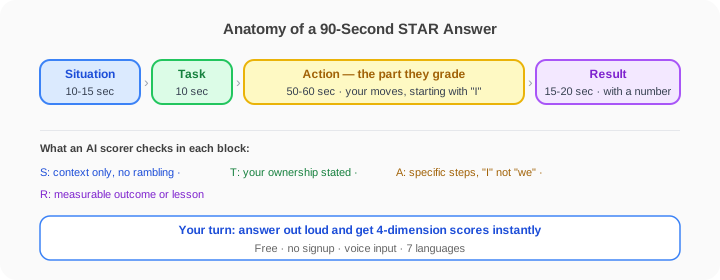
The 4 Steps in STAR, Timed
Before the questions themselves: every model answer below follows this budget. The Action block is where interviews are won — most candidates spend it backwards, with three minutes of setup and twenty seconds of “so we fixed it.”
- • Situation — 10-15 seconds: who, where, what happened. Context only, no story yet.
- • Task — 10 seconds: the responsibility that was yours, in first person.
- • Action — 50-60 seconds: your specific moves, each starting with “I”.
- • Result — 15-20 seconds: a measurable outcome or a concrete lesson.
Need the acronym first? See what STAR stands for, or go deeper on the framework in the STAR method guide.
10 STAR Method Questions and Model Answers
Handling challengesTell me about a time you faced an unexpected challenge at work.
S: Our payment vendor deprecated their API two weeks before Black Friday, mid-quarter.
T: As the senior backend engineer, I owned checkout reliability for the season.
A: I audited every call site, negotiated a 10-day extension with the vendor's support team, pair-wrote the webhook migration with a junior dev, and added regression tests before rollout.
R: We launched on time and checkout errors dropped 12% because the rewrite fixed a latent bug.
Scoring check: Scorer checks Action for three personal moves — a migration story with only "we upgraded the API" loses Action points.
Working under pressureDescribe a situation where you had to work under pressure.
S: Two days before our annual conference, the caterer canceled a 300-person order.
T: As events coordinator I had to feed everyone without blowing the budget.
A: I called five local restaurants, negotiated a bulk-price combo from two of them, and re-timed the agenda so lunch service started 20 minutes later.
R: Every attendee was served on the new schedule, and the combo deal saved 8% of the food budget.
Scoring check: Scorer checks Result for a number. "It went fine" scores low; "served 300, saved 8%" scores high.
Dealing with conflictTell me about a time you disagreed with a coworker.
S: My co-designer wanted three onboarding screens; my funnel data said each screen lost signups.
T: We owned the onboarding redesign jointly and had to ship in two weeks.
A: I proposed a one-week A/B test instead of debating opinions, built the single-screen variant myself, and shared results in our weekly review.
R: The single-screen version converted 22% better; we shipped it, and the disagreement ended with data, not rank.
Scoring check: Scorer flags blame language ("he refused to listen") — a classic conflict-answer red flag. This answer keeps the conflict structural, not personal.
Dealing with failureTell me about a time you failed. What did you learn?
S: I shipped a search feature that scored poorly in beta and I defended the design anyway.
T: I was the product owner and the launch decision was mine.
A: After full rollout the feature's usage flatlined, so I ran ten user interviews, found the filter UI was invisible on mobile, and rebuilt it as a persistent toolbar.
R: Usage tripled in six weeks. I learned to treat beta dislike as signal, not noise — and now I book interviews before defending anything.
Scoring check: Scorer checks that the Result contains a lesson plus a fix — failure answers ending in "I learned to be humble" score low.
Leadership without authorityGive me an example of leading a project without formal authority.
S: Our three teams each maintained duplicate reporting scripts costing ~6 hours a week combined.
T: Nobody "owned" fixing it; I volunteered to consolidate without any direct reports.
A: I mapped all three scripts, built a merged prototype, won each team lead's review by crediting their logic, and ran a two-week parallel period before cutover.
R: The merged pipeline cut reporting time to 45 minutes a week and became the team's standard tool.
Scoring check: Scorer checks Task for explicit ownership language — "I volunteered" beats "it was decided".
Going above and beyondDescribe a time you went above and beyond for a customer.
S: A small-business customer emailed that our tooling broke their invoicing export right at month-end.
T: As a support engineer, SLA gave me 24 hours — she needed it in 3.
A: I reproduced the CSV bug in an hour, hotfixed the parser, then stayed on a screenshare while she re-ran her whole month's exports and spot-checked them.
R: She invoiced on time, and her account team signed a two-year renewal; the fix also prevented a bug class for 4,000 users.
Scoring check: Scorer rewards "personal cost / extra step" signals in Action (the screenshare) — generic "I helped the customer" reads hollow.
Learning quicklyTell me about a time you had to learn something quickly.
S: Our analytics contractor vanished mid-migration and our dashboards ran on their custom SQL dialect.
T: I had ten days to take the pipeline in-house with zero experience in that dialect.
A: I reverse-engineered the three core queries, documented the dialect quirks as I went, and paired daily with our warehouse admin to validate each rewrite.
R: All dashboards came back online on day 9, and my quirk notes became the onboarding doc for the next two analysts.
Scoring check: Scorer checks Action specificity — naming the actual learning method beats "I'm a fast learner".
Prioritizing under constraintsDescribe a situation where you had too many things to do.
S: Mid-quarter my team absorbed two departing engineers' projects on top of our roadmap.
T: I had to protect the revenue-critical launch with a third less capacity.
A: I scored every open item by launch dependency, killed or paused four nice-to-haves with written rationales to stakeholders, and negotiated one deadline slip on a low-risk feature.
R: We shipped the launch on time, and two of the paused items turned out to be unnecessary — the audit paid for itself.
Scoring check: Scorer looks for the hard call (killing work) in Action — answers where everything got done "by working late" miss the point.
Customer serviceGive an example of handling an angry customer.
S: A customer called furious after a late delivery arrived damaged — the second failure in a month.
T: As the shift supervisor I could approve refunds up to $200 without escalation.
A: I let her finish venting without interrupting, repeated back the two concrete failures, issued the refund before she asked, and replaced the order overnight at my discretion.
R: She canceled the refund request once the replacement arrived, and her follow-up survey was the team's first 5/5 that quarter.
Scoring check: This is the answer type behind "star method interview questions and answers customer service" searches — scorer checks Action for named, owned moves, not "we made them happy".
AdaptabilityTell me about a time you adapted to a sudden change.
S: Four weeks before our product launch, our company announced an acquisition freeze on all new marketing spend.
T: I ran the launch campaign and the paid budget — its main engine — was now zero.
A: I pivoted to owned channels: rewrote the plan around our newsletter, a partner cross-promo I negotiated for free, and a founder AMA, re-cutting the timeline around them.
R: Launch hit 71% of the original sign-up target on zero paid spend, and the newsletter became our highest-CAC-efficiency channel.
Scoring check: Scorer checks Result honesty — claiming 100%+ of target under a freeze reads invented; 71% with a channel lesson reads real.
Don't Write 10 Answers — Write 5 Stories
The answers above come from one story bank. Behavioral questions cluster into five themes, and one well-drilled STAR story usually covers several:
| Your story (example) | Challenge | Conflict | Leadership | Pressure | Failure |
|---|---|---|---|---|---|
| Emergency API migration before Black Friday | ✓ | — | ✓ | ✓ | — |
| A/B test that settled a design dispute | — | ✓ | ✓ | — | ✓ |
| Zero-budget relaunch after a spending freeze | ✓ | — | ✓ | ✓ | — |
Build 5-6 stories like these rows, then drill each from 3-4 question angles — that is what the 10-minute STAR drill is built around. Full worked examples with breakdowns live on the STAR method example answers page.
Frequently Asked Questions
How do you answer STAR method questions?
Answer in four deliberate beats: state the Situation in two sentences of context only, name your Task (your actual responsibility, in first person), spend 50-60 seconds on Action — the specific moves you personally made — then close with a Result that has a number or a concrete lesson. Keep the whole answer under two minutes.
What is a STAR answer in an interview?
A STAR answer is a structured response to a behavioral question that covers Situation (the context), Task (your responsibility), Action (what you specifically did), and Result (the measurable outcome). Interviewers use it as evidence: the format forces a real past example instead of hypotheticals or generalities.
When should you use the STAR method in an interview?
Use STAR whenever a question asks for evidence from your past — anything starting with "Tell me about a time," "Describe a situation," "Give me an example," or "Have you ever." That covers most behavioral rounds at Amazon, Google, and large companies, plus situational questions rephrased as past experience.
Should you use the STAR method for every interview question?
No. STAR is for behavioral evidence, not for "Why this company?", salary, or rapid-fire technical questions, where it sounds canned. A useful rule: if the interviewer wants a story, use STAR; if they want reasoning or preferences, answer directly and keep STAR in your back pocket for follow-ups like "can you give me an example?"
Can you practice STAR answers for free without signing up?
Yes — StarInterview's practice tool scores you on all four STAR dimensions instantly with no account. Answer out loud with the mic (or type), get Situation/Task/Action/Result scores in seconds, and repeat in 7 languages if you're preparing in a non-native language.
What are the most common STAR method interview questions?
The stems that repeat across almost every behavioral interview: unexpected challenge, tight deadline or pressure, conflict with a coworker, failure and lesson learned, leadership without authority, going above and beyond for a customer, learning quickly, juggling competing priorities, handling an angry customer, and adapting to sudden change.