Phone Interview Questions and Answers: 10 Examples That Fit the Clock (2026)
The direct answer: phone interview questions and answers work best when every reply fits 30–60 spoken seconds, because a phone screen is a 15–30 minute logistics check — the recruiter is confirming experience, salary range, start date, and clear communication before spending panel time on you. Below: the 10 questions recruiters actually ask, each with a model answer under 80 words you can say out loud today, plus the free tool to score your voice.
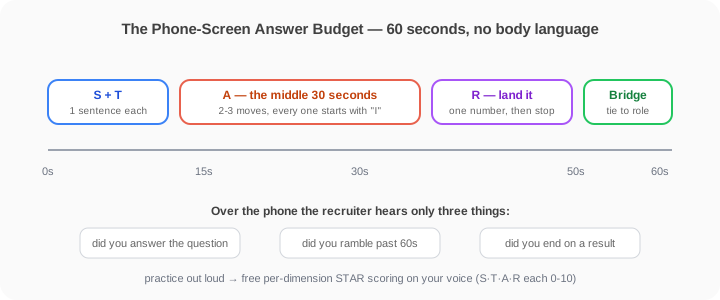
The 60-Second Answer Budget (Why Written-Style Answers Fail on the Phone)
Almost every phone-interview guide hands you a 200-word written paragraph. Nobody has 200 seconds to spare in a 15-minute screen with five sections to cover — and on the phone, a long answer can’t be skimmed, so rambling is worse than silent. The fix is a compressed STAR with a fixed sentence budget:
- • Situation + Task: one sentence each (≈15 seconds). Context, then your responsibility in first person.
- • Action: the middle 30 seconds — two or three moves, each starting with “I”. This is the only part interviewers reward.
- • Result: one number, then stop (≈10 seconds). Don’t trail off into “and yeah, it was a good learning experience…”.
- • Bridge: one sentence tying the result to their role. On the phone this is your close — there is no handshake.
The budget only works if you rehearse it aloud. Our free practice tool scores your spoken answer on all four STAR dimensions (Situation, Task, Action, Result, each 0–10) and flags exactly where you blew past 60 seconds — no signup, and it runs in all 7 supported languages, so non-native speakers can drill in the language of the actual call. See the 10-minute STAR drill for the daily routine, or turn any question into a draft with the free answer generator.
The 10 Phone Screen Questions, With Spoken-Ready Answers
Tell me about yourself.
Keep it to present → past → future, under 45 seconds: “I’m a customer success specialist with four years in SaaS, currently handling renewals for a 200-account book. Before that I started in support, which is why I stay calm when a renewal call goes sideways. I’m looking at this role because it puts that retention experience straight onto onboarding, which is the part of the cycle I want to own.” full tell-me-about-yourself formula page.
Why are you interested in this role?
Name one thing in the job description, then connect it to one thing in your record: “Your posting says this team is rebuilding its partner funnel from scratch. That’s the exact problem I solved at my last job — I took a stalled referral program from 40 to 310 partner signups in nine months, and I want to do that again with more runway.” Specific beats enthusiastic every time.
Why are you leaving your current job?
Stay positive, stay short, aim the answer forward: “I’ve learned a lot in my current role and I’m grateful for the team, but scope stopped growing eighteen months ago — I’ve run the same two product lines since then. This role owns the full lifecycle, which is the stretch I’m ready for.” Never badmouth the employer; recruiters all talk.
What do you currently do, day to day?
Give the recruiter their checkbox list in one breath: “I run a team of five, own the email and chat queues, and report weekly on first-response time. Right now the number I’m closest to watching is resolution rate — 78 percent last quarter, up from 64 when I took the queue over.” One metric makes you real; a job-title recital makes you skimmable.
What are your salary expectations?
Give a range, anchor with market data, don’t name a single number first: “Based on comparable roles in this market and this scope, I’m looking at the 85 to 95 range. That said, total package matters more than base, so if you share the band you’re working within I can tell you honestly whether we’re aligned.” salary negotiation guides.
When could you start?
Answer in one sentence — logistics questions die of detail: “I need to give two weeks’ notice, so I could start the second Monday after an offer.” If you’re unemployed, the same shape works: “I can start within the week.” Don’t explain your lease, your notice politics, or your vacation plans.
Are you interviewing with other companies?
Be honest and unhurried: “Yes — I’m in conversation with two other teams at roughly the same stage, but this role is the one that fits the direction I want, which is why I took the call today.” Recruiters read total transparency as desperation and fake exclusivity as a lie; “active but prioritizing this” is the true middle.
Walk me through your relevant experience.
Map three bullets onto their three requirements, in their words: “You’re after someone who can build a reporting function from zero — I did that at X, hired and trained the first two analysts, and the dashboards we shipped cut the monthly close from nine days to two.” Mirror the job description’s vocabulary; a phone screen is literally a listening test.
Tell me about a time you dealt with a difficult situation.
On a phone screen, compress STAR to one sentence per letter: “Situation: our biggest client accused us of missing scope and froze payment. Task: de-escalate without conceding the contract. Action: I walked them line-by-line through the change log and offered one rebuild free. Result: the invoice cleared in a week and the account doubled the next year.” Sixty seconds, full stop. conflict resolution STAR answers.
Do you have any questions for us?
Always yes — have two ready. Ask about the job, not the perks: “What does success look like in the first six months?” and “Why is this position open — a new seat or a backfill?” Then one logistics line you actually need: “What are the next steps and roughly when would I hear back?” Never open with remote-policy or holiday questions on a first call.
Phone Interview FAQ (Real Questions, Direct Answers)
Is a phone interview a good sign?
Yes — a phone interview means your resume cleared the first filter and a human decided you were worth fifteen minutes of their calendar. It is not yet an offer signal, though: the call exists to rule out blockers (salary, notice period, communication) cheaply. The genuinely strong sign is what comes next: being handed to the hiring manager or a full panel.
How long does a phone interview last?
A recruiter phone screen usually runs 15 to 30 minutes; anything under ten minutes typically means logistics-only screening, and a call that runs past 30 minutes is a good sign — the recruiter stopped ticking boxes and started having a conversation. Plan your answers for 30-60 seconds each so you can fill time without needing it.
What kind of questions are asked in a phone interview?
Expect five families in this order: your background (tell me about yourself), motivation (why this role, why leaving), fit (relevant experience, one behavioral story), logistics (salary, start date, other interviews), and your questions back. Deep technical or multi-story behavioral grilling is saved for later rounds — the screen only asks enough to justify booking them.
What to ask at the end of a phone interview?
Ask two questions about the job and one about process: “What does success look like in six months?”, “Is this a new seat or a backfill?”, and “What are the next steps and when would I hear back?” These signal seriousness, cost the recruiter nothing to answer, and the last one gets you a follow-up date instead of silence.
How to prepare for a phone interview with a recruiter?
Rehearse out loud, not in your head: the recruiter hears pauses, hedging, and rambling that reading your notes never reveals. Say each answer to a timer until your three core stories land inside sixty seconds, keep the job description and your resume on the desk, stand up while you talk, and print one page of bullets — never paragraphs you’ll read.