STAR Method Interview Prep: The 7-Day Plan That Takes 15 Minutes a Day
The direct answer: effective STAR method interview prep takes seven days of 15-minute sessions — mine the job spec, build a grid of five real stories, keep Situation and Task to 30 seconds, rehearse the Action out loud, and rewrite only the dimension that scored worst. Re-reading sample answers builds recognition, not recall; talking against a timer with feedback is the only thing that survives interview pressure. The full day-by-day plan with done-checks is below.
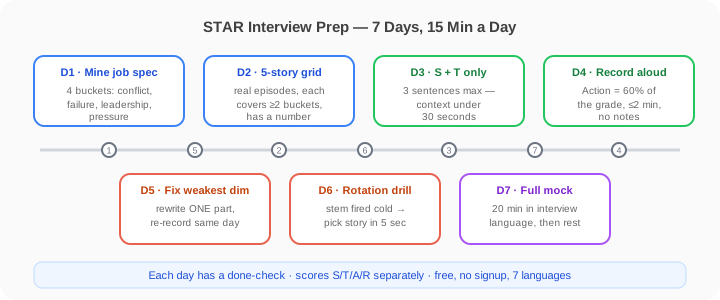
The 7-Day Plan, Day by Day
Every step has a done-check — if you cannot pass it, stay on that day and repeat. Most people searching “star method interview preparation” never get past Day 2 because there is no completion test; they collect guides instead of stories.
Day 1 — Mine the job spec for the 4 competencies they will probe
15 minRead the posting and highlight every soft-skill verb: “influence without authority”, “juggle priorities”, “handle ambiguity”. Circa 80% of behavioral questions map to 4 buckets — conflict, failure/learning, leadership/initiative, pressure/prioritization. Write down which 2 buckets this specific team stresses.
✔ Done when: You can name the 4 competencies this role will grade you on without re-reading the posting.
Day 2 — Build the 5-story grid
15 minList 5 real episodes from work, volunteering, study, or caregiving — one accomplishment, one conflict, one failure, one pressure moment, one thing you learned fast. Rules: each must have a number or named outcome, and none from your current team if you can help it (secrecy makes you vague). One story can cover several buckets — that is the point of a grid.
✔ Done when: A table of 5 stories × 4 buckets where every story covers at least 2 buckets.
Day 3 — Draft S and T only — 3 sentences max each
15 minFor each story write the Situation (what was going on, 2 sentences) and Task (your specific responsibility, 1 sentence). Do not write Action yet. Candidates ramble because S/T balloon — if context runs past 25 seconds, the interviewer stops scoring and starts waiting.
✔ Done when: Five S/T blocks you could read aloud in under 30 seconds total.
Day 4 — Record the Action aloud, get it scored
15–20 minSpeak each answer into a recorder (or a scored practice tool) with no notes, under 2 minutes. Action is 60% of the grade: it must be what YOU did, in order, with the hard parts included — the email you sent, the meeting you called, the option you rejected and why. Typing answers does not transfer to speaking them.
✔ Done when: Five recordings played back, with the weakest dimension per answer marked (S/T/A/R separately).
Day 5 — Rewrite only the weakest dimension
15 minDo not rewrite whole answers. If Action scored low, add one concrete step or decision point. If Result scored low, add the number, the reaction, or what changed after. One targeted fix per story, then re-record the same story the same day — the repeat is where retention happens.
✔ Done when: One re-recording per story that is measurably tighter than Day 4.
Day 6 — Rotation drill — questions cold, stories chosen in your head
15 minHave someone (or a question bank) fire question stems at you and only pick the story + first sentence aloud, not the whole answer. This trains retrieval, not recitation: real interviews ask oblique versions (“tell me about a time you disagreed with a decision” = your conflict story or your failure story — pick in 3 seconds).
✔ Done when: You matched 10 stems to stories in under 5 seconds each.
Day 7 — Full mock in interview conditions, then rest
25 minOne continuous 20-minute mock: 4 behavioral questions back to back, standing or sitting as you will on the day, in the language you will be interviewed in. Score it once more, note the single most common flaw across stories, fix only that. Then stop — cramming the night before degrades fluency.
✔ Done when: A mock recording where the same story flexes to two different question stems.
Why Scores, Not Reps, Decide the Order
The plan fixes one dimension per story because STAR answers fail unevenly. Our scoring model rates the four parts separately, and the patterns are stable across thousands of practice runs:
- • Situation too long — the classic non-native speaker risk: background detail crowds out Action. Cut until 2 sentences.
- • Task missing “I” — describing the team's goal instead of your responsibility reads as a passenger.
- • Action generic — “we communicated and found a solution” scores near zero; named steps, decisions and rejections score high.
- • Result unquantified — no number, no reaction, no “what changed after”. Even “my manager re-assigned me the next project” is a result.
Learn the format itself on the STAR method guide, or see the four parts dissected on live example answers. Then run the drill on the free STAR practice page — it is the same loop this plan uses, question by question.
STAR Interview Prep, Questioned Honestly
How do I prepare for a STAR interview?
Build 5 real stories, not answers to 50 questions. On Day 1–2 mine the job spec and list five episodes with outcomes; on Day 3–5 draft Situation/Task short, record the Action aloud, and rewrite only the dimension that scored worst; on Day 6–7 drill matching question stems to stories cold. Total load: about 15 minutes a day for a week.
How to prepare for interview using STAR method when you have no work experience?
The method is experience-blind. Use a group project where someone stopped contributing (conflict), a deadline you rescued (pressure), a skill you taught yourself (fast learning), a shift or volunteer role where you fixed a process (initiative), and anything that went wrong under your watch (failure). Interviewers grade the structure and honesty, not the prestige of the setting.
How long should it take to prep for an interview?
For behavioral rounds, 7 focused days at 15 minutes beats one panicked 4-hour session — retrieval and speech fluency only build with spaced repetition. If your interview is tomorrow: do Day 2 (story grid), Day 4 (record two stories aloud), and Day 6 (stem-matching drill) only. Skip re-reading guides; talking is the skill being tested.
What are the best STAR method interview prep questions?
Prepare for stems, not exact questions: “tell me about a time you failed”, “describe a conflict with a coworker”, “a time you disagreed with your manager”, “when you had too many priorities”, “a time you learned something quickly”. These five stems absorb most behavioral questions — and they are exactly what your 5-story grid covers, so one story answers several stems.
Is a STAR method interview prep guide or PDF enough?
A guide teaches the format; it cannot check your delivery. The failure mode is writing polished answers you never say aloud — under pressure they collapse. Whatever guide you use, add one thing: record yourself and get feedback on the four dimensions separately. That step is what turns a read guide into interview-ready recall.
How do you practice STAR answers without a partner?
Three solo loops: (1) answer aloud against a 2-minute timer, play it back, mark which STAR dimension was weakest; (2) re-record only fixing that dimension; (3) run a question-stem list and choose your story in 5 seconds without answering fully. A free scored tool replaces the partner by rating S, T, A and R individually — harder to fake than a friend saying “sounded good”.
What is the biggest STAR preparation mistake?
Preparing answers instead of stories. Interviewers rotate wording, so a memorized answer breaks the moment it is asked sideways. Five deeply rehearsed stories, each able to answer several different stems, cover roughly 80% of a behavioral loop. The second mistake is practicing by typing — the output that gets graded is your voice at the 90-second mark.
Honest Limits of This Plan
Seven days is enough for behavioral rounds; it is not enough to rebuild a career narrative from nothing — if you truly cannot find five episodes, that is a resume/story audit problem before a STAR problem. The plan assumes you can record yourself; if speaking in your interview language is the real wall, run the whole week in that language (our tool scores voice answers in 7 languages) rather than drafting in English and translating. For role-specific question banks the grid plugs into, see the interview questions library — and if you only need drafts to react to, the answer generator is the 5-minute shortcut this plan replaces.