By Elara T · August 2026
15 Common Interview Mistakes (And How to Fix Them)
Most interview rejections come down to avoidable mistakes. This guide walks you through the 15 most common pitfalls — organized by phase — and gives you concrete fixes so you can walk into your next interview with confidence.
You can be the most qualified candidate in the room and still lose the offer because of a few preventable missteps. Interviewers are not just evaluating your technical skills — they are assessing how you communicate, how you prepare, and how you present yourself.
The good news is that every mistake on this list is fixable. Whether you are preparing for a behavioral interview, a software engineering interview, or a general hiring conversation, these principles apply across the board. Let's break them down by phase.
Before the Interview
1. Not Researching the Company
❌ Mistake: Walking into an interview without understanding what the company does, its mission, recent news, or the products it builds. When asked "Why do you want to work here?" you draw a blank or give a generic answer.
✅ Fix: Spend at least 30 minutes reviewing the company's website, recent blog posts, press releases, and Glassdoor reviews. Understand their core product, target market, and competitive landscape. Prepare two or three specific reasons why the company excites you — and mention them naturally during the conversation.
2. Not Preparing STAR Stories
❌ Mistake: Trying to improvise answers to behavioral questions like "Tell me about a time you dealt with conflict." Without structure, your answers become rambling, unfocused, and forgettable.
✅ Fix: Prepare five to seven STAR stories (Situation, Task, Action, Result) that cover common themes: leadership, conflict, failure, teamwork, and initiative. Practice each one until you can deliver it in under two minutes. Our full behavioral interview guide walks you through this process step by step.
3. Not Preparing Questions to Ask
❌ Mistake: When the interviewer says "Do you have any questions for me?" you say "No, I think we covered everything." This signals low interest and missed the chance to evaluate the role yourself.
✅ Fix: Prepare four to five thoughtful questions in advance. Ask about team culture, the biggest challenges the team is facing, success metrics for the role, and what the onboarding process looks like. Good questions show genuine curiosity and critical thinking.
4. Not Practicing Out Loud
❌ Mistake: Thinking through answers in your head but never saying them aloud. What sounds polished in your mind often comes out disjointed and awkward when spoken for the first time in a high-pressure moment.
✅ Fix: Practice out loud — to a friend, in front of a mirror, or using an AI-powered tool. Recording yourself on your phone and playing it back is one of the fastest ways to catch filler words, pacing issues, and unclear phrasing. Try a mock session on our practice platform.
5. Not Preparing for Virtual Interviews
❌ Mistake: Treating a video interview like a casual call. Bad lighting, a cluttered background, microphone echo, or not knowing how to share your screen can all undermine an otherwise strong performance.
✅ Fix: Test your setup the day before. Check your camera angle (eye level), lighting (face a window or use a ring light), and microphone quality. Close unnecessary tabs, silence notifications, and have a glass of water nearby. Do a quick test call with a friend to catch technical issues early.
During the Interview
6. Being Too Vague
❌ Mistake: Giving answers like "I improved performance" or "I helped the team succeed" without any specifics. Vague answers are impossible for interviewers to evaluate and make you blend in with every other candidate.
✅ Fix: Be specific. Replace "I improved performance" with "I reduced API response time by 40% by implementing Redis caching on our three most-hit endpoints." Concrete details make your stories memorable and credible. This is especially critical in technical interviews where precision matters.
7. Saying "We" Instead of "I"
❌ Mistake: "We redesigned the architecture," "We launched the feature," "We resolved the incident." The interviewer has no idea what you personally did. Overusing "we" can make it seem like you are hiding behind your team.
✅ Fix: Use "I" to describe your actions and "we" only for team context. Example: "Our team was responsible for migrating the payment service. I led the design of the new data model and wrote the migration scripts that moved 2 million records with zero downtime." This balance shows you are a team player who also takes ownership.
8. Rambling for More Than 2 Minutes
❌ Mistake: Once you start talking, you cannot stop. You add unnecessary context, repeat yourself, and lose the thread of your own answer. The interviewer's eyes glaze over, and you eat into time that could be spent on other questions.
✅ Fix: Time your practice answers. Aim for 60 to 90 seconds. Use a clear structure — STAR for behavioral questions, problem → approach → outcome for technical ones. If you notice yourself going long, wrap up: "I can go into more detail if you'd like, but the key outcome was…" Concise answers show respect for the interviewer's time and demonstrate communication skills.
9. Not Quantifying Results
❌ Mistake: Describing what you did but never measuring the impact. "I built a new dashboard" is forgettable. Without numbers, interviewers cannot gauge the scale or significance of your work.
✅ Fix: Attach a number to every result you can. Revenue saved, time reduced, users impacted, error rate decreased, or conversion rate increased. Even estimates are better than nothing: "reduced onboarding time from about two weeks to three days." Numbers make your contributions tangible.
10. Badmouthing Previous Employers
❌ Mistake: Complaining about your old boss, criticizing your previous company's culture, or venting frustration about past projects. Even if your complaints are valid, negativity raises red flags about your professionalism and attitude.
✅ Fix: Frame difficult experiences as learning opportunities. Instead of "My manager was terrible at communication," say "I learned how important clear communication is, and I now proactively set up weekly check-ins with my team." This shows maturity and self-awareness — qualities every hiring manager values.
11. Not Asking Questions
❌ Mistake: Sitting silently when given the chance to ask questions. This is different from not having questions prepared — sometimes candidates have them but forget in the moment, or assume asking questions is optional.
✅ Fix: Treat your questions as part of the interview. Bring a notebook with your questions written down. Ask follow-up questions based on what was discussed during the interview. This turns the conversation into a two-way dialogue and shows you are evaluating the opportunity seriously.
12. Checking Your Phone
❌ Mistake: Glancing at your phone during the interview — even for a split second. It communicates that the interview is not your priority. In virtual interviews, typing on a keyboard while the interviewer is speaking has the same effect.
✅ Fix: Silence your phone and put it in your bag or face-down on the table before the interview starts. For virtual interviews, close all messaging apps and disable notifications. If you need to take notes, tell the interviewer upfront: "I'm going to jot down a few notes — please let me know if that's distracting."
After the Interview
13. Not Sending a Thank-You Note
❌ Mistake: Leaving the interview and doing nothing. Many candidates assume the interview speaks for itself. But in competitive hiring processes, a thoughtful thank-you email can be the tiebreaker.
✅ Fix: Send a brief, personalized thank-you email within 24 hours. Reference something specific from the conversation — a project the team is working on, a challenge they mentioned, or a topic you connected on. Keep it under 150 words. Example: "Thank you for taking the time to discuss the platform team's migration to Kubernetes. The complexity you described is exactly the kind of challenge I'm looking for."
14. Not Following Up
❌ Mistake: After sending the thank-you note, you wait passively. A week goes by, then two, and you never check in. You assume no news is good news — or that following up makes you look desperate.
✅ Fix: If the interviewer gave you a timeline, wait until it passes by a day or two, then send a polite follow-up. If no timeline was given, follow up after one week. Keep it short: "Hi [Name], I wanted to follow up on our conversation last week. I remain very excited about the opportunity and would love to know about next steps." Following up shows initiative — a trait employers want.
15. Not Reflecting on What Went Well
❌ Mistake: Whether you get the offer or not, you move on without reviewing your performance. This means you repeat the same mistakes in your next interview and never build on your strengths.
✅ Fix: Within an hour of the interview, write down three things that went well and two things you want to improve. Note any questions you stumbled on so you can prepare better answers. Over time, this practice compounds — each interview makes you sharper. For ongoing improvement, use our practice platform to rehearse weak areas.
Frequently Asked Questions
What is the biggest mistake people make in interviews?
The single biggest mistake is failing to prepare. Walking into an interview without researching the company, practicing answers, or preparing questions signals a lack of interest and effort. Candidates who prepare consistently outperform those who wing it.
How long should an interview answer be?
Aim for 60 to 90 seconds per answer. Long enough to cover the situation, action, and result using the STAR method, but short enough to keep the interviewer engaged. If you exceed two minutes, you are likely rambling.
Should I send a thank-you email after every interview?
Yes. A brief, personalized thank-you email sent within 24 hours reinforces your interest, gives you a chance to address anything you missed, and keeps you top of mind. Skipping it is a missed opportunity.
Is it bad to say "we" instead of "I" in an interview?
Interviewers want to understand your individual contribution. Saying "we" occasionally is fine, but overusing it makes it unclear what you personally accomplished. Balance team context with clear ownership using "I" statements.
How do I recover if I make a mistake during an interview?
Stay calm and acknowledge it briefly if needed. If you gave a poor answer, you can circle back later: "Earlier, I wanted to add something about X." Most interviewers appreciate self-awareness and composure under pressure.
Ready to Practice Without the Pressure?
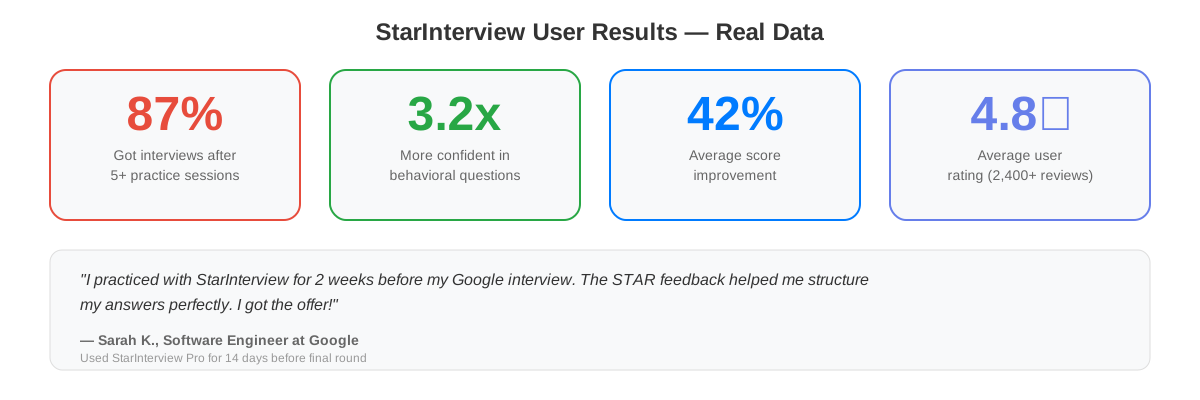
Avoiding these mistakes is easier when you have a safe space to practice. StarInterview gives you AI-powered mock interviews with real-time feedback so you can fix your weak spots before the real thing.
Related Guides
- The Complete Behavioral Interview Guide— Master the STAR method and prepare winning stories.
- Software Engineer Interview Prep— Technical and behavioral preparation for engineering roles.
- Tech Interview Preparation Guide— Comprehensive preparation for technical interviews.