Career Guide
30 Behavioral Interview Questions and Answers: The Complete STAR Method Guide
By Elara T · August 2026 · 18 min read
Behavioral interview questions are the single most common type of interview question you will face in 2026. According to recent hiring surveys, over 73% of hiring managers use behavioral questions as their primary evaluation tool, and candidates who answer them well are significantly more likely to receive offers. Yet most job seekers walk into interviews unprepared, hoping to improvise their way through questions about leadership, conflict, and failure.
This guide changes that. Below you will find 30 carefully selected behavioral interview questions organized across six critical competency categories: Leadership, Teamwork, Conflict Resolution, Problem Solving, Failure and Learning, and Communication. Each category includes five essential questions plus a detailed sample answer using the STAR method so you can see exactly how to structure your own responses.
Whether you are preparing for a software engineer interview, a management role, or any position that requires strong interpersonal skills, mastering these questions will give you a decisive advantage. For deeper preparation, explore our complete behavioral interview masterclass or jump straight into AI-powered practice sessions to test your answers with real-time feedback.
The STAR Method: A Quick Refresher
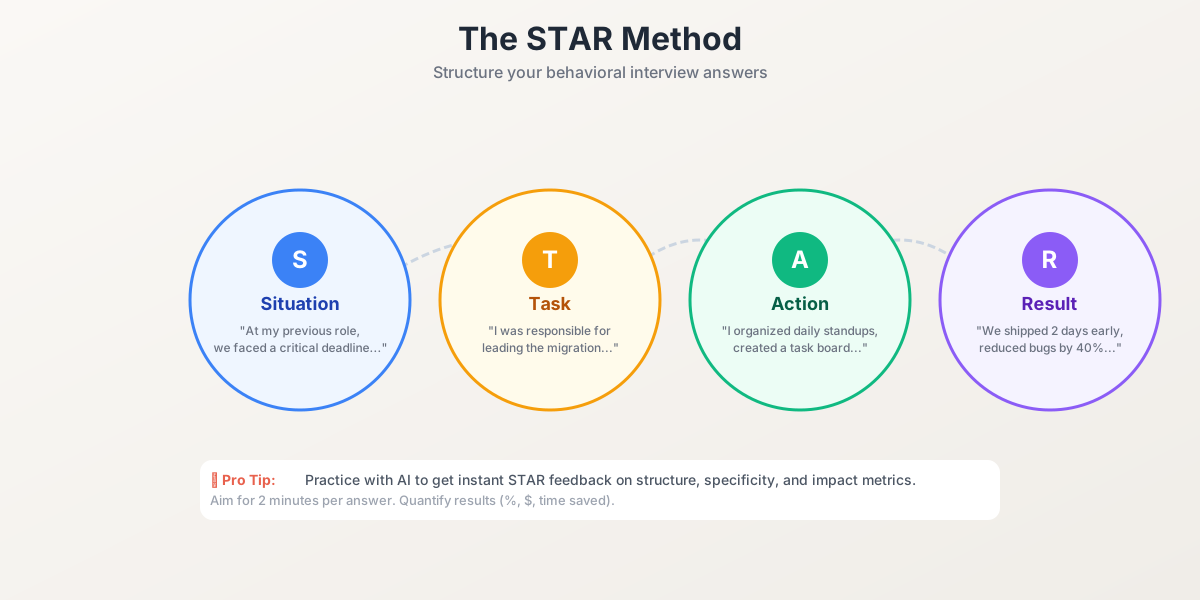
Before we dive into the questions, let us review the STAR framework. STAR stands for Situation, Task, Action, Result — a structured approach to answering behavioral interview questions that ensures your responses are specific, organized, and impactful. Interviewers love STAR because it gives them concrete evidence of your abilities rather than vague claims.
- SITUATIONSet the scene. Describe the context — where you were, what was happening, and why it mattered.
- TASKExplain your specific responsibility or challenge. What were you expected to accomplish?
- ACTIONDetail the steps you took. This should be the longest part of your answer — be specific about what you did.
- RESULTShare the outcome. Use metrics and data whenever possible. What happened because of your actions?
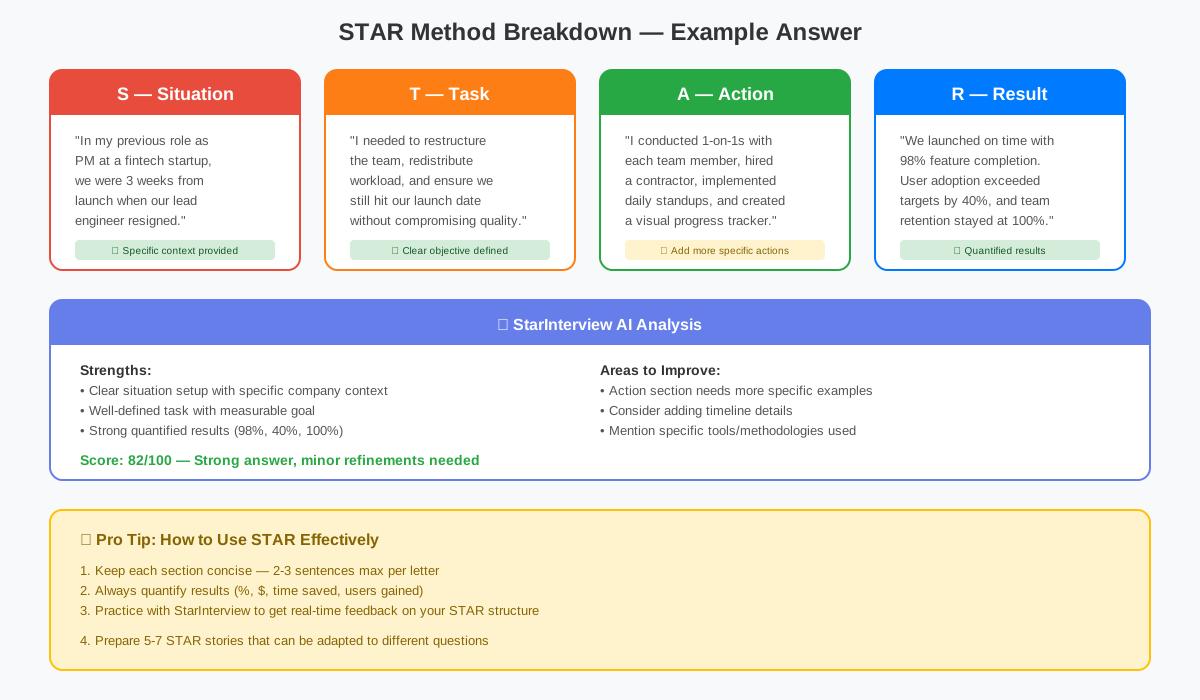
The goal is to deliver each STAR answer in about 2–3 minutes. The Action component should take the most time, as this is where you demonstrate your skills and decision-making process. If you want to practice delivering STAR answers with AI feedback, try our practice tool to see how your responses score on clarity, structure, and impact.
Category 1: Leadership Questions
Leadership questions assess your ability to influence others, make decisions under pressure, and drive results through people — even if you have never held a formal management title. Interviewers want to see that you can take initiative, delegate effectively, and motivate a team toward a common goal.
5 Leadership Questions to Prepare
- Tell me about a time you had to lead a team through a difficult project.
- Describe a situation where you had to motivate an underperforming team member.
- Give an example of a time you made an unpopular decision as a leader.
- Tell me about a time you had to delegate tasks effectively to meet a deadline.
- Describe a situation where you stepped up to lead without being asked.
Detailed STAR Answer: Leading a Team Through a Difficult Project
SITUATIONIn my previous role at a mid-sized fintech company, our team was tasked with delivering a critical payment processing system migration. Six weeks before the deadline, two senior engineers left the company unexpectedly, reducing our team from eight to six people. The executive team was pushing for an on-time launch because the legacy system was experiencing frequent outages that were costing the company approximately $40,000 per month in lost revenue.
TASKAs the project lead, I needed to restructure the team, re-prioritize the remaining work, and deliver the migration without sacrificing quality or significantly delaying the timeline. I also had to maintain team morale during a stressful period where burnout was a real risk.
ACTIONFirst, I called an all-hands meeting with the remaining team to be transparent about the situation. I asked each person to honestly assess their capacity and any concerns. Then I reorganized the work: I moved non-critical features to a post-launch phase, reducing the scope by about 25%. I paired our mid-level engineers with a contractor I brought in, creating knowledge-sharing sessions that accelerated onboarding. I also took on technical design reviews myself to free up the engineers for implementation work. Every morning, I ran a 15-minute stand-up to identify blockers immediately, and every Friday I held a retro to adjust our approach. When one team member expressed burnout concerns, I re-assigned their most stressful module and gave them an extra day off that week.
RESULTWe launched the migration only one week behind the original deadline — a delay the executive team considered acceptable given the personnel loss. The new system reduced processing errors by 94% and eliminated the monthly outages entirely, recovering the $40,000 in lost revenue within the first month. Team morale remained strong throughout, and two team members specifically cited the project in their subsequent performance reviews as a highlight of their year. The experience taught me that transparent communication and flexible scope management are the most powerful tools a leader has during a crisis.
Category 2: Teamwork Questions
Teamwork questions evaluate how well you collaborate, support others, and contribute to a group dynamic. Employers want to know that you can work effectively with diverse personalities, share credit, and put team goals above individual recognition.
5 Teamwork Questions to Prepare
- Tell me about a time you worked with a difficult team member to achieve a goal.
- Describe a situation where you had to collaborate with a cross-functional team.
- Give an example of a time you supported a colleague who was struggling.
- Tell me about a successful team project and your specific contribution to it.
- Describe a time when you had to compromise your own idea for the good of the team.
Detailed STAR Answer: Collaborating Across Functions
SITUATIONOur company was launching a new customer onboarding flow that required tight coordination between engineering, design, marketing, and customer success. Each team had different priorities: engineering focused on technical feasibility, design wanted pixel-perfect UX, marketing needed the flow to support a new campaign timeline, and customer success was concerned about support ticket volume during the transition. The first two planning meetings devolved into competing priority debates with no resolution.
TASKAs the engineering lead, I was responsible for coordinating technical delivery but also needed to help align all four teams around a shared plan that met everyone's core requirements without causing a six-month delay.
ACTIONI proposed a working session structure where each team lead presented their top three requirements with clear rationale. I created a shared document mapping every requirement to its impact on timeline, technical complexity, and business value. We scored each requirement together using a simple framework: must-have for launch, nice-to-have for launch, and post-launch. This depersonalized the negotiation — we were evaluating requirements against criteria, not fighting for individual preferences. I also set up a shared Slack channel with weekly progress updates and a RACI chart so everyone knew who was responsible for what. When conflicts arose between design and engineering over animation complexity, I facilitated a compromise: we shipped a simplified version for launch with a plan to iterate in sprint two.
RESULTThe onboarding flow launched on time with 90% of the must-have requirements complete. Customer satisfaction scores for the onboarding experience increased by 34% compared to the previous flow, and support ticket volume actually decreased by 18% because the new design was more intuitive. The cross-functional framework we created became the template for future launches at the company. Marketing also reported that the campaign hit its engagement targets because the technical implementation properly supported their tracking requirements.
Category 3: Conflict Resolution Questions
Conflict resolution questions test your emotional intelligence, diplomacy, and ability to navigate disagreements constructively. Interviewers want to see that you can handle tension without escalating it, find common ground between opposing viewpoints, and maintain professional relationships even when you disagree.
5 Conflict Resolution Questions to Prepare
- Tell me about a time you disagreed with your manager. How did you handle it?
- Describe a situation where two team members were in conflict and you helped resolve it.
- Give an example of a time you had to deliver difficult feedback to a colleague.
- Tell me about a time you had to navigate competing priorities between stakeholders.
- Describe a situation where a client or customer was unhappy and you turned it around.
Detailed STAR Answer: Disagreeing with Your Manager
SITUATIONMy manager wanted to adopt a new database technology for our main product, based on a conference talk he had attended. After researching the technology, I believed it was not mature enough for our use case — the documentation was sparse, the community was small, and the migration would take at least three months with significant risk of data integrity issues. My manager was enthusiastic and had already mentioned it to the VP of Engineering.
TASKI needed to express my concerns respectfully without undermining my manager's credibility or damaging our working relationship. I also needed to ensure the team did not commit to a risky migration without a thorough evaluation.
ACTIONRather than challenging the decision publicly, I requested a one-on-one meeting with my manager. I came prepared with a detailed analysis comparing the proposed technology against two alternatives, including benchmarks from similar-sized companies, a risk assessment, and a migration cost estimate. I framed the conversation around shared goals — "I want us to make the best long-term decision" — rather than "you are wrong." I also suggested a compromise: we could run a small proof-of-concept with a non-critical service to validate the technology before committing to a full migration. My manager appreciated the preparation and agreed to the POC approach.
RESULTThe proof-of-concept confirmed my concerns — the database struggled with our read patterns and required significant workarounds. My manager acknowledged the findings and we chose an alternative that met our performance needs. The VP of Engineering appreciated our thorough evaluation process, and my manager and I built a stronger working relationship because of the transparent, data-driven dialogue. The experience reinforced my belief that respectful disagreement backed by evidence strengthens teams rather than weakening them.
Category 4: Problem Solving Questions
Problem solving questions reveal your analytical thinking, creativity, and ability to navigate ambiguity. Employers want to see how you break down complex problems, evaluate options, and make sound decisions — especially when there is no clear right answer. These questions are especially important in software engineer interviews and technical roles.
5 Problem Solving Questions to Prepare
- Tell me about a time you solved a problem that no one else could figure out.
- Describe a situation where you had to make a decision with incomplete information.
- Give an example of a time you identified a problem before it became critical.
- Tell me about a time you had to think creatively to overcome a resource constraint.
- Describe a complex problem you broke down into manageable parts to solve.
Detailed STAR Answer: Solving a Critical Production Issue
SITUATIONOur e-commerce platform experienced intermittent checkout failures that affected approximately 5% of transactions during peak hours. The issue had persisted for three weeks. Previous debugging efforts by two other engineers had not identified the root cause because the errors were sporadic, not reproducible in staging, and the logs showed no obvious patterns. Customer complaints were increasing and the business was estimating $120,000 in monthly revenue loss.
TASKI was asked to investigate and resolve the issue as quickly as possible. The challenge was that standard debugging approaches had already failed, so I needed to think differently about how to isolate the problem.
ACTIONI started by adding detailed instrumentation to the checkout flow — not just error logging, but timing metrics at every step. I set up a dashboard that correlated failed transactions with server load, time of day, user geography, and payment provider. After 48 hours of data collection, I noticed that failures clustered around a specific 30-second window when our database connection pool was being recycled. The connection pool recycling was triggered by a scheduled maintenance job that ran every six hours. During the recycling window, new checkout requests that needed database connections were hitting a timeout. The reason previous engineers missed this was that the logs showed connection timeouts as "transient errors" which were being silently retried — succeeding on the second attempt for most users but failing completely for users whose sessions timed out during the retry window. I implemented connection pool draining (graceful handoff instead of hard recycling) and added monitoring alerts for connection pool health.
RESULTThe fix eliminated the checkout failures completely. Transaction success rates returned to 99.7%, recovering the estimated $120,000 in monthly revenue. The monitoring dashboard I built became a permanent tool for the team and later caught two other performance issues before they impacted customers. I wrote up a post-mortem document that became part of our engineering onboarding, teaching new engineers the value of comprehensive instrumentation over log-based debugging alone.
Category 5: Failure and Learning Questions
Failure questions are among the most challenging behavioral questions because they require vulnerability and self-awareness. Interviewers ask these not to judge you for making mistakes, but to evaluate your ability to take ownership, learn from setbacks, and grow professionally. How you respond to failure often reveals more about your character than how you handle success.
5 Failure and Learning Questions to Prepare
- Tell me about a time you failed at something important. What did you learn?
- Describe a situation where you made a mistake that impacted your team.
- Give an example of a time you received critical feedback. How did you respond?
- Tell me about a time a project you were responsible for did not meet expectations.
- Describe a professional skill gap you identified and how you addressed it.
Detailed STAR Answer: Learning from a Failed Project
SITUATIONEarly in my career, I was the technical lead on an internal tool project to build a custom reporting dashboard for our sales team. I was confident in my technical abilities and decided to build the entire system using a new JavaScript framework I had been wanting to learn. I did not consult the sales team extensively about their requirements because I assumed I understood what they needed from a brief initial meeting. I also chose an ambitious architecture that I thought would impress my engineering manager.
TASKMy responsibility was to deliver a functional reporting tool within two months that would help the sales team track pipeline metrics and generate client-facing reports. Instead, I delivered a technically sophisticated tool that the sales team found unusable after two months of work.
ACTIONWhen the sales team reviewed the initial build, their feedback was harsh but fair: the dashboard did not include the three metrics they cared about most, the export format was wrong, and the new framework had compatibility issues with their browser environment. I had to completely reassess my approach. First, I took full ownership of the failure in a meeting with my manager — no excuses about tight timelines or vague requirements. Then I scheduled individual interviews with five sales team members to understand their actual workflows. I abandoned the fancy framework and rebuilt the tool using a proven stack the team already knew. I implemented a two-week sprint cycle where the sales team reviewed each increment and gave feedback before I continued building. I also started a personal practice of writing requirement documents with explicit sign-off from stakeholders before writing any code.
RESULTThe rebuilt tool launched four weeks later and achieved 95% adoption within the sales team within the first month. More importantly, the experience fundamentally changed how I approach projects. I now conduct stakeholder interviews before every project, write requirement documents with sign-off, and use incremental delivery with regular feedback loops. My manager noted in my next review that my post-failure response demonstrated stronger engineering leadership than the original project would have if it had succeeded. The lesson was clear: technical skill without empathy for your users produces impressive failures, not useful products.
Category 6: Communication Questions
Communication questions assess your ability to convey complex ideas clearly, tailor your message to different audiences, and listen effectively. Strong communicators can explain technical concepts to non-technical stakeholders, present ideas persuasively, and ensure alignment across teams. These skills are especially critical for senior roles and client-facing positions.
5 Communication Questions to Prepare
- Tell me about a time you had to explain a complex concept to a non-technical audience.
- Describe a situation where miscommunication caused a problem. How did you fix it?
- Give an example of a time you had to persuade someone to adopt your idea.
- Tell me about a time you delivered a presentation that went exceptionally well.
- Describe a situation where active listening helped you solve a problem or avoid a mistake.
Detailed STAR Answer: Explaining Technical Concepts to Non-Technical Stakeholders
SITUATIONOur engineering team identified that the company needed to migrate from a monolithic architecture to microservices to support scaling. The CTO supported the initiative, but the executive team — CEO, CFO, and VP of Sales — was skeptical. They saw it as an expensive technical project with no clear business benefit, and the CFO was concerned about the estimated $300,000 investment over six months. Previous attempts by engineers to explain the need had used heavy jargon and focused on technical elegance rather than business impact.
TASKI was asked to present the case for the migration to the executive team in a way they could understand and support. I needed to translate technical concepts into business language and demonstrate clear ROI.
ACTIONI completely reframed the presentation. Instead of talking about microservices, containers, and service meshes, I told a story about the business. I opened with three specific incidents where our current system had caused revenue loss or customer churn — with dollar amounts attached. I used a simple analogy: "Our current system is like a single fuse box for an entire building. When one circuit blows, the whole building goes dark. We need to install separate circuit breakers so that a problem in one room does not shut down everything." I presented a clear timeline with milestone-based funding — the CFO could stop investment at any milestone if results were not materializing. I included a competitive analysis showing that three of our top five competitors had already completed similar migrations. I also prepared a one-page executive summary with the three most important numbers: expected revenue protection ($500K annually), competitive risk of inaction, and a timeline with decision gates.
RESULTThe executive team approved the migration unanimously. The CFO specifically commented that it was the first time an engineering proposal made complete business sense to him. The project was completed on budget, and within the first year after migration, system downtime decreased by 87% and we successfully launched three new product features that would have been impossible on the monolith. The presentation approach became a template for how engineering communicated technical initiatives to leadership, and I was asked to train other engineers on executive communication. The key lesson was that technical credibility is built not by demonstrating complexity, but by making complexity invisible to your audience.
Pro Tips for Answering Behavioral Questions
- Prepare versatile stories. Have 8–10 stories ready that each demonstrate multiple competencies. A single story can answer leadership, teamwork, and problem-solving questions depending on which angle you emphasize.
- Quantify your results. Numbers make your answers memorable and credible. Instead of "improved performance," say "reduced page load time from 4.2 seconds to 1.1 seconds, increasing conversion by 23%."
- Practice out loud. Silent reading does not prepare you for the pressure of speaking under observation. Use our AI practice tool to rehearse with real-time feedback on pacing, clarity, and structure.
- Be honest about failures. Interviewers can detect rehearsed perfection. Authentic stories about real challenges — and genuine lessons learned — are far more compelling than fabricated success stories.
- Tailor to the role. Research the company and role to understand which competencies matter most. A leadership role demands more leadership stories; an individual contributor role at a collaborative company needs more teamwork examples.
- Keep it recent. Prioritize stories from the last 2–3 years. Older examples can make it seem like you have not grown recently. If you must use an older story, frame it as a foundational experience that continues to influence your approach.
Practice These Questions with AI Feedback
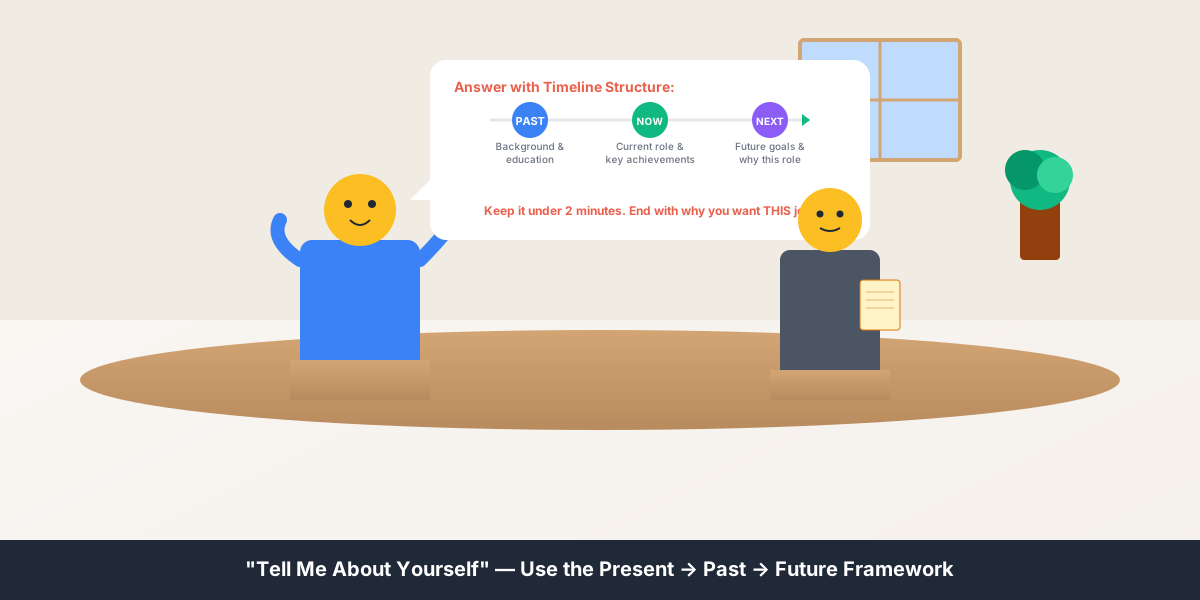
StarInterview gives you real-time STAR method analysis, clarity scoring, and personalized improvement suggestions for every behavioral answer you practice.
Start Practicing Free →Frequently Asked Questions
How many behavioral questions should I prepare before an interview?
You should prepare at least 8–10 versatile stories that can be adapted to different behavioral questions. Each story should cover a distinct situation from your professional experience and demonstrate different competencies. With well-prepared stories using the STAR method, you can answer most behavioral questions confidently, even when the exact question catches you off guard. Practice each story until you can deliver it in 2–3 minutes.
What is the STAR method and why do interviewers use it?
STAR stands for Situation, Task, Action, and Result. It is a structured framework that helps candidates organize their behavioral interview answers with clear context, specific responsibilities, concrete actions taken, and measurable outcomes. Interviewers use STAR because it provides a consistent way to evaluate candidates and reduces the impact of subjective bias. Research shows that structured behavioral interviews are significantly more predictive of job performance than unstructured conversations.
Can I use the same story for multiple behavioral interview questions?
Yes, you can and should reuse stories across different questions, but you need to adjust the emphasis. A single project experience might demonstrate leadership, teamwork, conflict resolution, and problem-solving depending on which aspects you highlight. The key is to tailor the Task and Action components to match what the question is asking. However, avoid using the same story more than twice in a single interview — it can make you appear one-dimensional.
How long should a behavioral interview answer be?
A well-structured STAR answer should take 2–3 minutes to deliver. Anything under 60 seconds likely lacks sufficient detail, while answers over 4 minutes risk losing the interviewer's attention. The Situation and Task components should take about 30 seconds combined, the Action section should be the longest at 60–90 seconds, and the Result should take about 30 seconds with specific metrics when possible. Practice with a timer to develop natural pacing.
What if I don't have professional experience for a behavioral question?
You can draw from academic projects, volunteer work, extracurricular activities, freelance projects, or personal initiatives — not just traditional employment. Many entry-level candidates successfully use university group projects, student organization leadership, hackathon experiences, or open-source contributions as their behavioral interview stories. The interviewer cares about the skills and thought process you demonstrate, not whether the situation occurred in a corporate office. Just be honest about the context.