Interview Guide
How to Answer “Tell Me About Yourself” in a Job Interview
By Elara T · August 2026 · 10 min read
Every job interview starts the same way. You sit down, exchange pleasantries, and then the interviewer leans forward and says: “So, tell me about yourself.” It sounds simple. It sounds casual. And yet, this single question trips up more candidates than any technical problem or behavioral scenario that follows it.
The reason is straightforward: “Tell me about yourself” is deceptively open-ended. There is no right answer, but there are plenty of wrong ones. Rambling for five minutes about your childhood, reciting your resume line by line, or freezing up with a blank stare — all of these leave a bad first impression that takes the rest of the interview to recover from.
The good news is that this question is entirely predictable, which means you can prepare a strong answer that sounds natural and sets the tone for the entire conversation. In this guide, I will walk you through the Present-Past-Future framework — the gold standard for structuring your response — and give you five complete example answers tailored to different roles. By the end, you will have a clear template you can customize for any interview.
If you are preparing for a specific role, check out our dedicated guides for software engineer interviews, product manager interviews, data analyst interviews, and behavioral interviews.
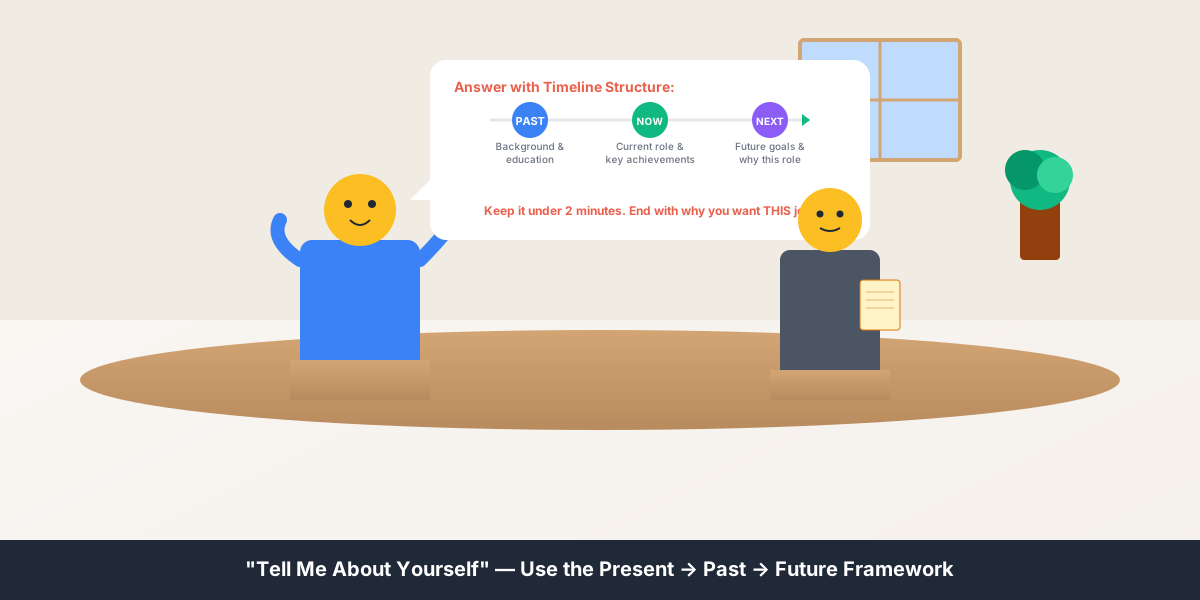
Why Interviewers Ask “Tell Me About Yourself”
Before you can craft a great answer, you need to understand what the interviewer is actually evaluating. This question is not a throwaway icebreaker — it is a carefully chosen opening that reveals several things simultaneously.
First, the interviewer wants to see how you structure information under pressure. Can you organize your thoughts into a coherent narrative, or do you ramble without direction? Second, they are looking for relevance. Do you connect your background to the role, or do you share everything indiscriminately? Third, they are gauging your communication style. Are you confident, concise, and engaging — or monotone and recited?
Understanding these three dimensions — structure, relevance, and delivery — gives you the foundation for building an answer that works every time.
The Present-Past-Future Framework
The most effective way to answer “Tell me about yourself” is to follow a simple three-part structure: Present → Past → Future. This framework works because it mirrors how humans naturally tell stories — starting with where you are now, explaining how you got here, and then sharing where you are headed.
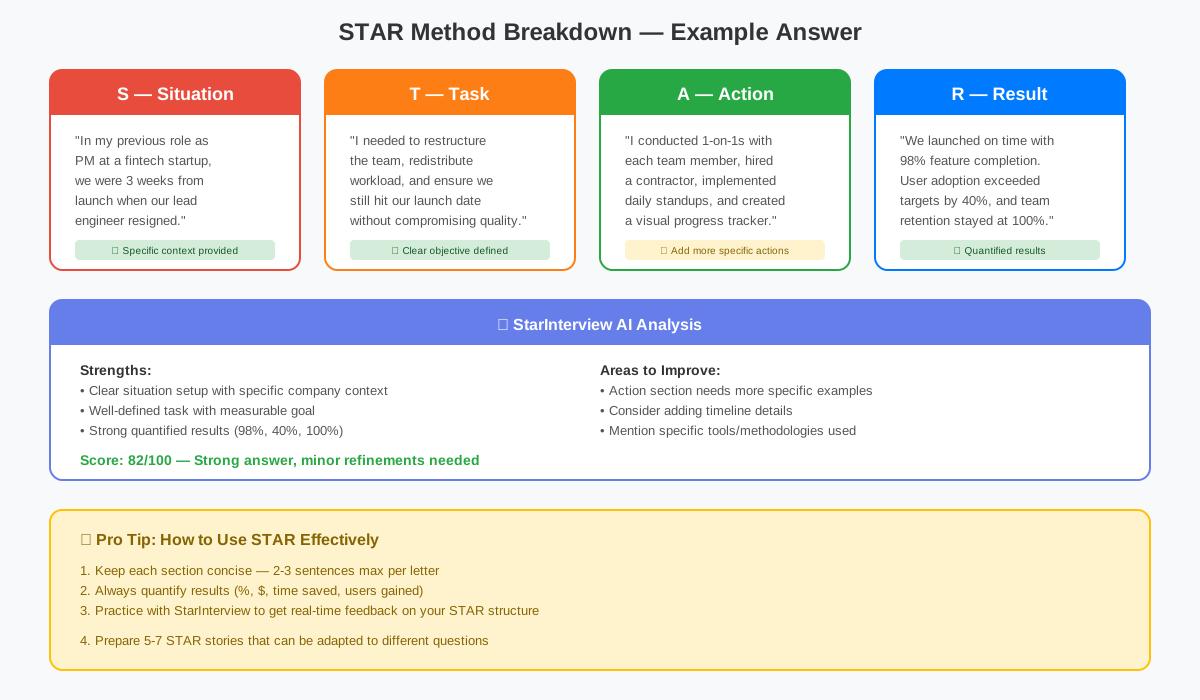
Present: Where You Are Now
Start with your current professional situation. If you are employed, describe your current role, the company you work for, and your primary responsibilities. If you are a student or recently unemployed, talk about what you have been focused on — your degree, a certification you completed, or a project you have been building. This section should be one to two sentences that immediately establish your professional identity.
Example: “I am currently a senior software engineer at a mid-size fintech company, where I lead a team of four developers building our payment processing platform.”
Past: How You Got Here
Next, bridge backward to one or two relevant experiences that shaped your skills and led you to this point. Do not list every job you have ever had. Instead, pick the experiences most relevant to the role you are interviewing for and highlight one or two specific accomplishments. Use the STAR method as a mental checklist — make sure you include a result or impact wherever possible.
Example: “Before that, I spent three years at a startup where I built their entire backend infrastructure from scratch, scaling it from zero to handling fifty thousand transactions per day.”
Future: Where You Are Going
Close by connecting your trajectory to this specific role and company. Explain why you are excited about the opportunity and how it fits into your professional goals. This is where you show that you have done your research and that you are not just looking for any job — you are looking for this job.
Example: “Now I am looking to move into a larger-scale environment where I can apply my experience with distributed systems. Your team’s work on real-time data infrastructure is exactly the kind of challenge I want to take on next.”
When you combine all three parts, you get a 60-to-90-second answer that tells a clear, compelling story: here is who I am professionally, here is what I have accomplished, and here is why I am sitting in front of you today.
5 Example Answers for Different Roles
Below are five complete example answers using the Present-Past-Future framework. Each one is written in a conversational tone and tailored to a specific role. Use these as templates — not scripts. Replace the details with your own experiences and adjust the language to match how you naturally speak.
1. Software Engineer
“I am currently a backend engineer at a healthcare startup, where I design and maintain the APIs that power our patient-facing telehealth platform. Over the past two years, I have led the migration from a monolithic architecture to microservices, which reduced our deployment time from forty-five minutes to under five and cut our cloud infrastructure costs by thirty percent. Before joining the startup, I spent three years at a consulting firm working across multiple client projects — everything from e-commerce platforms to logistics systems — which gave me a broad exposure to different tech stacks and problem domains. I also contributed to two open-source libraries for API rate limiting, which deepened my understanding of system design tradeoffs. What excites me about this role is the scale of the engineering challenges you are tackling. Moving from a startup environment to a team that handles millions of requests per day is exactly the kind of growth trajectory I have been working toward, and I think my experience building resilient distributed systems would translate well here.”
Want more practice? See our full Software Engineer Interview Guide.
2. Product Manager
“I am a product manager at a B2B SaaS company, where I own the onboarding and activation experience for our self-serve product. My focus over the last year has been reducing time-to-value for new users — I redesigned our onboarding flow based on user research and analytics, which increased our trial-to-paid conversion rate from twelve percent to twenty-one percent in six months. Prior to product management, I spent four years as a data analyst, which taught me how to dig into metrics, build dashboards, and make evidence-based decisions. That analytical foundation has been invaluable because I approach product problems with a quantitative mindset that many PMs lack. I also spent a year working directly with enterprise customers in a customer success role, which gave me empathy for the user and a strong understanding of how B2B buyers make decisions. I am excited about this opportunity because your product sits at the intersection of AI and workflow automation, which is where I believe the next generation of enterprise tools is heading. I want to be part of building that future.”
Read our complete Product Manager Interview Guide.
3. Data Analyst
“I currently work as a data analyst at a mid-size e-commerce company, where I support the marketing and product teams with insights that drive growth strategy. My day-to-day work involves building dashboards in Tableau, running A/B test analyses in Python, and presenting findings to stakeholders who need clear, actionable takeaways. One project I am particularly proud of: I built a customer segmentation model that identified three high-value segments the marketing team had been overlooking, which led to a targeted campaign that generated an additional four hundred thousand dollars in quarterly revenue. Before this role, I completed a data science bootcamp and spent a year as a business intelligence intern at a logistics company, where I first discovered how much I enjoy turning messy data into strategic insights. I have also been building my skills in machine learning — I recently completed a certificate in applied ML through Stanford Online. I am drawn to this role because of the emphasis on using data to shape product decisions at scale, which is the direction I want to grow my career.”
Explore our Data Analyst Interview Guide for more preparation strategies.
4. Marketing Manager
“I am a marketing manager at a direct-to-consumer wellness brand, where I lead a team of three and oversee our paid acquisition, email, and content channels. Over the past two years, I have scaled our monthly ad spend from twenty thousand to one hundred fifty thousand dollars while maintaining a blended return on ad spend above four to one. I also launched an email nurture sequence that improved our customer lifetime value by thirty-five percent through better segmentation and personalization. Before this, I worked at an agency for three years managing accounts for consumer brands ranging from beauty to food and beverage. Agency life taught me how to move fast, manage multiple priorities, and think creatively within tight budgets — skills that serve me every day as an in-house leader. What attracts me to your company is the mission and the stage you are at. You have built an incredible product and a loyal community, and I see a huge opportunity to accelerate growth through performance marketing and brand storytelling. That combination is exactly what energizes me.”
Looking for more marketing-specific guidance? Check out our Marketing Manager Interview Guide.
5. Recent Graduate
“I just graduated with a degree in information systems from the University of Michigan, where I focused on data analytics and human-computer interaction. During school, I completed two internships — the first was a summer at a nonprofit where I built their first-ever reporting dashboard in Google Data Studio, which the executive team now uses for monthly board presentations. The second was at a tech company last summer, where I worked on the product analytics team and ran experiments that helped increase user retention by eight percent. I also served as president of the university’s Women in Tech club, where I organized a campus-wide hackathon with over two hundred participants and secured partnerships with four companies. Those leadership experiences taught me how to communicate with diverse stakeholders, manage timelines, and stay organized under pressure. I am excited about this role because it combines my analytical skills with the opportunity to work cross-functionally with product and engineering teams, which is where I see my career heading.”
For more entry-level strategies, see our guide on the STAR method for fresh graduates.
5 Common Mistakes to Avoid
Knowing what to do is only half the battle. Here are the five most common mistakes I see candidates make when answering this question — and how to avoid each one.
The interviewer already has your resume. Listing every job title and date is a wasted opportunity. Instead, pick the highlights that matter most for this role and weave them into a narrative.
Your interviewer does not need to know about your childhood, your pets, or your favorite vacation. Keep the focus on your professional journey. Personal details are fine only if they directly connect to the role or company mission.
If your answer exceeds two minutes, you have lost the room. The interviewer is mentally checking their watch after ninety seconds. Practice with a timer. Hit your key beats and stop. You can always expand on details when they ask follow-up questions.
“I am a hard worker who is passionate about technology” tells the interviewer nothing. Replace generic claims with specific accomplishments and measurable results. Numbers, outcomes, and concrete examples make your answer memorable.
Your answer should build toward a clear reason why you are here. If you finish your response and the interviewer is not sure why you want this job, you missed the landing. The “Future” portion of your answer is where you make that connection explicit.
Adapting Your Answer for Different Interview Stages
The Present-Past-Future framework stays the same, but the emphasis and level of detail you provide should shift depending on where you are in the interview process.
Phone Screen (Recruiter Call)
Keep it short and high-level. Recruiters are screening for basic fit — do you have the right background, and are your salary and location expectations aligned? Spend thirty to forty-five seconds on your answer. Focus on your current role and one key reason you are interested in this position. Save the detailed accomplishments for later rounds. Your goal here is to earn a second conversation, not to close the deal.
On-Site Interview (Hiring Manager)
This is where you go deeper. The hiring manager wants to understand the substance behind your resume. Take sixty to ninety seconds and include a specific accomplishment or two that demonstrate the skills they care about most. Tailor the “Past” section to mirror the job description. If the role emphasizes cross-functional leadership, make sure your story highlights a time you led across teams. Use the job posting as your cheat sheet — it tells you exactly what to emphasize.
Final Round (Executive or Panel)
By the final round, the team already knows you can do the job — they are evaluating cultural fit and long-term potential. Your answer should lean more heavily on the “Future” section. Show that you have thought deeply about the company’s mission, the team’s direction, and how you see yourself contributing over the next two to three years. You can also weave in a brief mention of values or work style that aligns with the company culture. At this stage, the “why you” matters as much as the “who you are.”
No matter which stage you are at, practicing your answer out loud is essential. You do not want the first time you say these words to be in the actual interview.
Quick-Reference Template
Present: “I am currently a [title] at [company], where I [main responsibility and one key achievement].”
Past: “Before that, I [relevant experience] where I [specific accomplishment with measurable result].”
Future: “I am now looking to [career goal], and [company name] is the ideal place to do that because [specific reason tied to the role or company].”
Fill in the blanks with your own details, practice delivering it naturally, and adjust the emphasis based on the interview stage. That is all you need.
Practice Your Answer With AI Feedback
Record your “Tell me about yourself” answer and get instant AI-powered feedback on structure, pacing, filler words, and delivery.
Try StarInterview Free →Frequently Asked Questions
How long should my "Tell Me About Yourself" answer be?
Aim for 60 to 90 seconds. That is roughly 150 to 250 words when spoken at a natural pace. Anything shorter feels underprepared; anything longer risks losing the interviewer's attention. The goal is to give a concise professional narrative that sets up the rest of the conversation, not to recite your entire resume.
Should I mention personal hobbies or interests in my answer?
Only if a hobby directly connects to the role or demonstrates a relevant skill. For example, mentioning that you lead a volunteer coding workshop shows leadership and teaching ability — both valuable in a senior engineering role. Avoid unrelated personal details like your favorite TV show or weekend plans. Keep the focus professional and purposeful.
Is the Present-Past-Future framework better than other methods?
The Present-Past-Future framework is the most widely recommended structure because it creates a natural narrative arc that interviewers can follow easily. Other frameworks like STAR or CAR work well for behavioral questions but feel overly structured for an introductory question. Present-Past-Future gives you flexibility while still providing enough structure to keep your answer focused and coherent.
What if I am a career changer with no direct experience in the new field?
Focus on transferable skills and the story of why you are making the change. In your "Past" section, highlight experiences and accomplishments that translate to the new role — project management, data analysis, stakeholder communication, or problem-solving. In your "Future" section, explain your motivation for the transition and how your unique background gives you a fresh perspective that traditional candidates might lack.
How do I practice my answer without sounding robotic or rehearsed?
Practice the key beats of your answer — not a word-for-word script. Write down the three to four main points you want to hit under Present, Past, and Future, then rehearse speaking to those points naturally. Record yourself on video and watch it back. Tools like StarInterview give you AI-powered feedback on pacing, filler words, and delivery so you can sound polished without sounding memorized. The goal is confident familiarity, not recitation.
Related Guides
- Behavioral Interview Questions: STAR Method Masterclass
- The Complete Software Engineer Interview Guide (2026)
- System Design Interview Guide: Architecture & Scalability
- Product Manager Interview Prep: Questions, Frameworks & Strategies
- Data Analyst Interview Guide: SQL, Python & Behavioral Questions
- Behavioral Interview Questions: STAR Method Masterclass
- STAR Method for Fresh Graduates: Your First Interview Playbook