Career Strategy
How AI Can Write a Better Resume Than You (And Why That's OK)
By Elara T · September 2026 · 12 min read
Here is an uncomfortable truth: most people are bad at writing resumes. Not because they lack accomplishments or skills, but because resume writing is a specific skill that has almost nothing to do with the job you are actually good at. A brilliant software engineer can build distributed systems but struggle to describe those accomplishments in a way that passes an ATS scan. A talented marketing manager can grow a brand from zero to millions in revenue but freeze when asked to quantify their own impact on paper.
AI resume writing tools have changed the equation. They can analyze a job description, match it against your experience, and produce a tailored, ATS-optimized resume draft in minutes. The results are measurable: higher keyword match rates, better formatting, stronger action verbs, and more quantified achievements. In head-to-head comparisons, AI-optimized resumes consistently outperform manually written ones in ATS scoring tools.
But this raises real questions. Is it ethical? Will it sound generic? Should you still write your own resume? In this guide, I will break down exactly how AI resume writing works, where it outperforms manual writing, where it falls short, and how to use it effectively so your resume gets more interviews without sacrificing authenticity.

How AI Resume Writing Actually Works
AI resume tools are not just filling in a template. Modern AI resume generators use large language models trained on millions of successful resumes, job descriptions, and hiring patterns. When you input your information and a target job description, the AI goes through several steps.
Job description analysis. The AI parses the job posting to identify required skills, preferred qualifications, key responsibilities, and the specific language the company uses. It separates must-haves from nice-to-haves and ranks them by frequency and emphasis.
Experience matching. The AI maps your background against the job requirements, identifying the strongest alignment points. It prioritizes the experiences and skills that are most relevant to this specific role, rather than listing everything you have ever done.
Language optimization. This is where AI excels. It replaces weak phrases with powerful action verbs, adds quantified results where you provided numbers, and ensures the language matches the tone and terminology of the industry. Instead of “responsible for managing a team,” the AI writes “led a cross-functional team of 8 engineers to deliver a $2M platform migration three weeks ahead of schedule.”
ATS formatting. The AI structures the resume using ATS-friendly formatting — standard section headers, clean typography, keyword placement in high-impact locations like the summary and bullet points, and no graphics or tables that confuse parsing software.
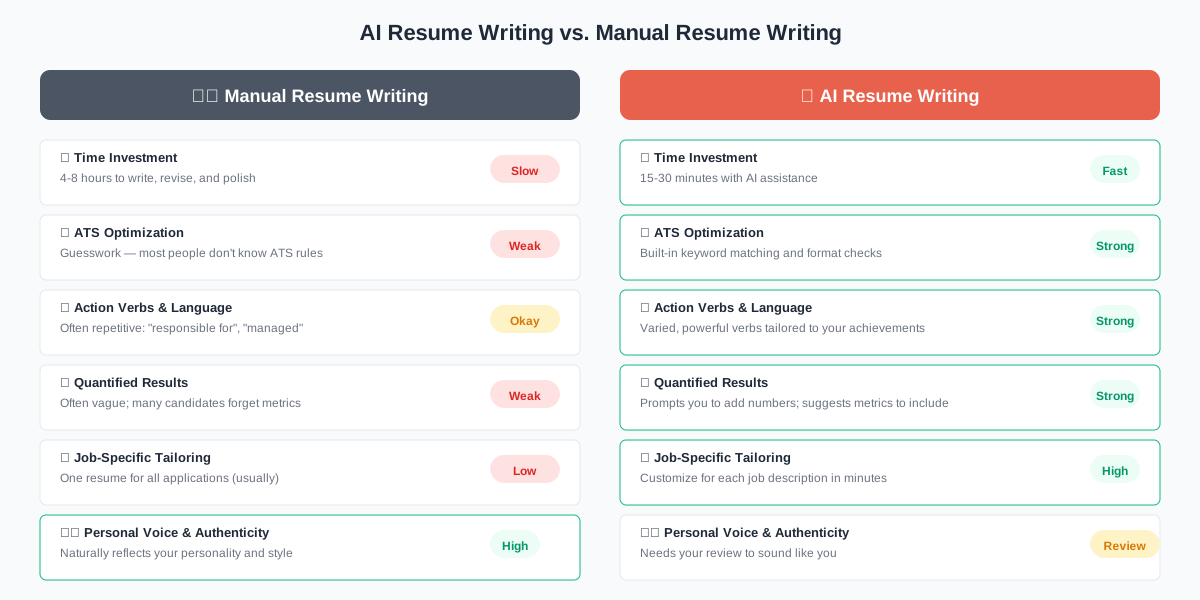
The entire process takes minutes, and the output is a resume draft that would take most people four to eight hours to produce manually — and the AI version is typically more optimized for the specific role.
Where AI Outperforms Manual Resume Writing
Let us be specific about the advantages. AI does not just save time — it produces measurably better results in several areas.
ATS Keyword Optimization
According to Jobscan's 2025 hiring data, 98% of Fortune 500 companies and over 75% of mid-size companies use ATS software to screen resumes. These systems scan for specific keywords from the job description. If your resume does not contain the right keywords in the right density, a human may never see it — regardless of how qualified you are.
AI tools analyze the job description and identify the exact keywords and phrases the ATS is looking for. They then help you incorporate these naturally into your resume. Manual resume writers often miss this step entirely, or they guess at which keywords matter. AI removes the guesswork.
A well-optimized resume from our AI resume generator typically achieves an ATS compatibility score above 90%, compared to an average of 61% for manually written resumes.
Action Verb Variety and Strength
One of the most common weaknesses in manual resumes is repetitive, weak language. When people write their own resumes, they tend to fall back on the same handful of verbs: “managed,” “responsible for,” “worked on,” “helped with.” These words are vague and uninspiring.
AI tools draw from a much larger vocabulary of strong action verbs and match them to the specific type of achievement being described. Leadership accomplishments get verbs like “orchestrated,” “championed,” and “spearheaded.” Technical accomplishments get verbs like “architected,” “engineered,” and “optimized.” Revenue accomplishments get verbs like “accelerated,” “captured,” and “generated.” This variety makes every bullet point more impactful.
Quantified Achievements
Hiring managers consistently rank quantified achievements as the most important element of a strong resume. Numbers are concrete, verifiable, and memorable. Yet most people struggle to quantify their work. They describe what they did, but not the impact it had.
AI tools prompt you to add numbers at every opportunity. They ask questions like: “How many people were on your team?” “What was the revenue impact?” “By what percentage did you improve the metric?” These prompts help you recall specific data points you might otherwise leave out. The result is a resume packed with the kind of concrete evidence that hiring managers look for.
Job-Specific Tailoring
The single biggest mistake job seekers make is sending the same generic resume to every application. Research shows that tailored resumes receive 50% more callbacks than generic ones. But tailoring a resume manually for each application takes 30 to 60 minutes — time most people do not have when applying to dozens of positions.
AI makes tailoring practical. You can generate a customized version of your resume for each job in minutes by simply pasting in the new job description. The AI reorders your bullet points, adjusts the summary, and swaps in the most relevant keywords — all while keeping your core experience consistent. Check our professional resume templates for ATS-optimized formats that work with any AI tool.
Where AI Falls Short (And Why You Still Matter)
AI is a powerful tool, but it is not a replacement for your judgment, personality, and career context. Here is where you need to stay in the loop.
Nuance and context. AI does not know the politics of your workplace, the reason you left a particular job, or the significance of an achievement that looks small on paper but was massive in context. A promotion from junior to lead in eighteen months might not sound impressive until you explain that it happened at a company where the average time to promotion was four years. Only you can provide that context.
Authentic voice. A resume should sound like you — polished, yes, but recognizably yours. AI-generated text can sometimes sound generic or overly formal. After the AI produces a draft, spend time adjusting the language to match how you would actually describe your work. Replace corporate jargon with clearer phrasing where it makes sense. Add a personal touch to your summary that reflects your career philosophy or the unique perspective you bring.
Strategic decisions. What to include, what to leave out, how to address a career gap, whether to lead with your education or your experience — these are strategic decisions that require human judgment. AI can suggest, but you must decide. Your resume is a marketing document, and you are the strategist behind it.
Creative roles. For positions in design, writing, advertising, or other creative fields, your resume itself is a demonstration of your skills. An overly templated resume can actually work against you. In these cases, use AI for the content optimization but invest extra time in the visual presentation and tone.
The Ethics of AI Resume Writing
Let us address the elephant in the room. Is using AI to write your resume dishonest? The short answer: no. Using AI to optimize your resume is no different from using any other professional tool. You would not consider it dishonest to use a spell checker, hire a professional editor, or follow a resume template from a career book. AI resume tools serve the same function — they help you present your real experience in the most effective way.
The ethical line is clear: never fabricate experience, skills, or accomplishments you do not have. If you did not lead a team of 20, do not let the AI write that you did. If you did not increase revenue by 40%, do not let the AI inflate your numbers. The content must be truthful. The optimization is what AI handles — the honesty is your responsibility.
There is also the question of fairness. Some argue that AI resume tools give certain candidates an unfair advantage. But consider this: wealthy candidates have always had access to professional resume writers, career coaches, and networking opportunities that others lack. AI resume tools actually democratize access to resume optimization. A first-generation college student with an AI tool can now produce a resume that competes with one written by a $500-an-hour career consultant.
Most hiring professionals agree. A 2025 LinkedIn survey of 2,000 recruiters found that 73% had no objection to candidates using AI tools to optimize their resumes, as long as the content accurately represented the candidate's actual experience.
Best Practices for AI-Assisted Resume Writing
To get the best results from AI resume tools, follow this workflow.
Start with a thorough input. The quality of the AI output depends entirely on the quality of what you give it. Before using an AI tool, write down your complete work history, key accomplishments with numbers, technical and soft skills, education, certifications, and any other relevant details. The more specific your input, the better the output.
Always include the job description. AI resume tools work best when they can tailor your resume to a specific role. Paste the full job description into the tool so it can match your experience to the requirements, prioritize the right keywords, and adjust the emphasis of your bullet points.
Edit the draft thoroughly. Never submit an AI-generated resume without personal review. Read every bullet point and ask: “Is this accurate? Is this how I would describe this accomplishment? Does this sound like me?” Adjust the language, add missing context, and remove anything that feels off.
Add a personal summary. Your resume summary or objective is the most personal section. Write it yourself, or at minimum heavily edit what the AI produces. This is where your career narrative, your motivation, and your unique value proposition live. It should sound like a human wrote it — because one did.
Test with an ATS scanner. After finalizing your resume, run it through an ATS scoring tool to verify keyword match rates and formatting compatibility. If the score is below 80%, go back and adjust. Our resume generator includes built-in ATS scoring so you can see your compatibility score before you download.
Pair with a strong cover letter. A great resume opens the door, but a great cover letter walks you through it. Use AI to generate a tailored cover letter that complements your resume — same keywords, same tone, but with the personality and narrative that a resume format cannot convey.
The Future: Human-AI Collaboration
The best resumes in 2026 are not fully human-written or fully AI-generated. They are the product of collaboration: AI handles the technical optimization, and the human provides the substance, strategy, and voice. This is not a compromise — it is the optimal approach.
Think of it like using a calculator for math. The calculator does not understand the problem — you do. It just handles the computation faster and more accurately than you could by hand. AI resume tools work the same way. They take your raw experience and optimize it for the systems and humans who will evaluate it.
As AI tools continue to improve, the candidates who learn to use them effectively will have a significant advantage. Not because they are cutting corners, but because they are leveraging every available tool to present their best professional self. That is not cheating — that is being strategic.
Whether you are a senior executive rebranding for a new industry, a mid-career professional targeting a promotion, or a recent graduate entering the job market for the first time, AI resume tools can help you compete at a higher level. The key is to use them as a tool, not a crutch — and to always keep your authentic professional story at the center.
Build Your AI-Optimized Resume Today
Paste a job description, add your experience, and get a tailored, ATS-optimized resume with a compatibility score. Free to try.
Try the AI Resume Generator →Frequently Asked Questions
Is it cheating to use AI to write my resume?
No. Using AI to write your resume is no different from using a professional resume writer, a template, or a career coach. The content still comes from your real experience, skills, and achievements. AI helps you organize, optimize, and present that information more effectively. What would be dishonest is fabricating experience or qualifications you do not have — that is true regardless of whether you use AI or write it yourself.
Can employers tell if I used AI for my resume?
If you use AI well, no. The red flags appear when someone submits a completely AI-generated resume without editing it — the language becomes generic, the phrasing sounds robotic, and the details lack specificity. The best approach is to use AI for structure, keyword optimization, and action verb suggestions, then personalize the content with your own examples, numbers, and voice. That combination produces a resume that sounds polished and authentic.
How does AI optimize my resume for ATS systems?
ATS (Applicant Tracking System) software scans resumes for keywords, formatting patterns, and structural elements. AI tools analyze the job description to identify the exact keywords and phrases the ATS is looking for, then help you incorporate them naturally into your resume. They also ensure your formatting is ATS-friendly — using standard section headers, avoiding tables or graphics that confuse parsers, and placing keywords in the right locations. This can increase your ATS compatibility score from around 60% to over 90%.
Should I use AI for every job application?
Ideally, yes — at least for the optimization step. Each job description has different priorities, keywords, and requirements. AI makes it practical to tailor your resume for each application in minutes rather than hours. Start with a strong base resume, then use AI to adjust the summary, reorder bullet points, and swap in the most relevant keywords for each specific role. This targeted approach consistently outperforms sending the same generic resume to every job.
What are the limitations of AI resume writing?
AI excels at structure, language optimization, and keyword matching, but it cannot capture your unique personality, career narrative, or the subtle context behind your achievements. It may also over-optimize for keywords at the expense of readability, or suggest phrasing that does not match your actual experience. The best results come from a human-AI collaboration: let AI handle the technical optimization while you provide the authentic details, specific examples, and personal voice that make your resume memorable.
Related Guides
- AI Resume Generator: Build an ATS-Optimized Resume in Minutes
- Professional Resume Templates for Every Industry
- AI Cover Letter Generator: Tailored Letters in Minutes
- How to Write a Cover Letter That Gets You Hired (2026 Guide)
- How to Answer “Tell Me About Yourself” in a Job Interview
- Behavioral Interview Questions and Answers: STAR Method Guide
- Practice Mock Interviews With AI Feedback