Resume Writing
How to Write a Resume with No Experience: Complete 2026 Guide
By Elara T · September 2026 · 14 min read
Every job posting seems to require experience. “Entry-level position — 2–3 years of experience required.” It is the paradox that frustrates every fresh graduate and career changer: you need experience to get a job, but you need a job to get experience. If you have been staring at a blank document wondering what to put on your resume when you have never held a professional role, you are not alone.
Here is the good news: you do not need years of employment to write a strong resume. Employers hiring for entry-level roles know that candidates will have limited work history. What they are looking for is potential — demonstrated through your education, projects, skills, and initiative. A well-structured resume that highlights the right things will get you interviews, even with zero formal work experience.
This guide walks you through every step of building a compelling entry-level resume from scratch. We will cover what to include, how to structure it, what to avoid, and how to optimize it so both ATS software and human recruiters see a strong candidate — not an empty page.
Why You Can Still Write a Great Resume Without Experience
The assumption that a resume equals work history is outdated. In 2026, hiring managers and recruiters increasingly evaluate candidates on skills, potential, and cultural fit — not just past job titles. According to LinkedIn's 2025 Global Talent Trends report, 76% of hiring managers say they would consider a candidate with no formal experience if they demonstrated relevant skills through projects, coursework, or extracurricular activities.
Think about everything you have done that is relevant: the group project where you led the technical implementation, the personal app you built over a weekend, the volunteer event you organized for 200 attendees, the hackathon where your team placed in the top five. These are real accomplishments with real impact. The challenge is not a lack of substance — it is knowing how to frame what you already have.
The eight steps below will show you exactly how to do that.
Step 1: Start With a Strong Summary or Objective
Your resume summary sits at the top of the page, and it is the first thing a recruiter reads. For candidates with no experience, this section is especially important because it sets the context for everything that follows. A well-written summary tells the recruiter who you are, what you bring, and what you are looking for — in three sentences or fewer.
Avoid generic objectives like “motivated self-starter seeking an opportunity to learn and grow.” That says nothing. Instead, be specific. Name your degree or strongest qualification, mention a key skill or project, and state the role you are targeting. Here are two examples.
Weak: “Recent graduate seeking an entry-level position where I can utilize my skills and contribute to organizational success.”
Strong: “Data science graduate with hands-on experience building predictive models using Python and scikit-learn through academic research and a Kaggle competition top-10% finish. Seeking a junior data analyst role to apply statistical analysis skills to real-world business problems.”
The strong version is specific, mentions concrete skills and accomplishments, and targets a clear role. It gives the recruiter a reason to keep reading. Use our AI resume generator to draft a tailored summary that matches the job you are applying for.
Step 2: Highlight Your Education Strategically
For entry-level candidates, education moves to the top of the resume — above where work experience would normally go. But listing your degree, school, and graduation date is the bare minimum. To make your education section work harder, include details that demonstrate relevant knowledge and achievement.
GPA (if strong). If your GPA is 3.5 or above, include it. If your major GPA is higher than your overall GPA, list that instead. If neither is impressive, leave it out — you are not required to include it.
Relevant coursework. List four to six courses that directly relate to the job you are targeting. If you are applying for a software engineering role, include “Data Structures and Algorithms,” “Software Engineering Principles,” and “Database Systems.” Skip general education courses.
Honors and awards. Dean's list, academic scholarships, departmental awards, and cum laude distinctions all signal strong performance. Include them.
Thesis or capstone project. If you completed a thesis, capstone, or significant research project, describe it in one to two lines with the topic and methodology. This shows depth of knowledge and the ability to complete a long-form intellectual project — a skill that translates directly to the workplace.
Step 3: Showcase Your Projects
For candidates with no work experience, the projects section is the most important part of your resume. This is where you prove you can do the work, not just study it. Strong projects demonstrate initiative, technical ability, problem-solving, and follow-through — exactly what employers want to see.

Academic projects. Your senior design project, research assistantship, or class assignment can be a strong resume entry. Treat it like a work experience item: describe the problem, your role, the tools you used, and the outcome.
Personal projects. Built a weather app? Created a blog with a custom CMS? Designed a mobile game? Personal projects show self-motivation and genuine interest in your field. They are often more impressive to hiring managers than coursework because they require initiative that no one assigned.
Open-source contributions. Contributing to open-source projects demonstrates collaboration, code quality, and the ability to work within existing codebases. Even small contributions — fixing a bug, improving documentation, adding a feature — count.
Hackathon projects. Hackathons are proof that you can build something under pressure, work on a team, and deliver results in a compressed timeline. Mention the hackathon name, what your team built, your specific role, and any placement or recognition.
Step 4: List Transferable Skills (Soft and Hard)
Skills are the bridge between what you have done and what the employer needs. For entry-level candidates, a well-curated skills section can compensate for limited work history by showing you have the capabilities to do the job from day one.
Hard skills are specific, teachable abilities: programming languages, software tools, data analysis, foreign languages, certifications. List these explicitly and honestly. If you claim proficiency in Python, be prepared to demonstrate it in a technical interview or coding assessment.
Soft skills are interpersonal and transferable: communication, leadership, teamwork, problem-solving, time management. Do not just list these as bullet points — demonstrate them through your project descriptions and activities. “Led a four-person team to deliver a mobile app prototype in 48 hours at HackMIT” communicates leadership, teamwork, and time management far better than listing those three words in a skills section.
Tailor your skills to each job. Read the job description carefully and mirror the specific skills and tools they mention. If the posting asks for “experience with SQL and data visualization,” make sure those appear prominently in your skills section and are backed up by projects or coursework. Our ATS-friendly resume templates include a dedicated skills layout optimized for keyword matching.
Step 5: Include Volunteer Work, Extracurriculars, and Leadership
Many candidates with no formal experience overlook activities that are, in fact, highly relevant to employers. Volunteer work, student organizations, sports teams, and community involvement all demonstrate qualities that employers value: commitment, teamwork, leadership, and initiative.
Volunteer work. Organized a food drive? Tutored other students? Built a website for a nonprofit? These are legitimate experiences with real outcomes. Describe them the same way you would describe a job: your role, your responsibilities, and the results you achieved. “Coordinated a team of 12 volunteers to distribute 3,000 meals during a community food drive” is a resume-worthy bullet point.
Student organizations. Served as treasurer of the computer science club? Organized campus events? Managed social media for a student group? These roles involve real skills — budgeting, event planning, communication, project management — that translate directly to the workplace.
Leadership roles. Any position where you led others, managed resources, or made decisions counts. Captain of a sports team, president of a club, peer mentor, resident advisor — these roles demonstrate responsibility and leadership potential. Quantify the impact where possible: the number of members you managed, the budget you oversaw, the events you organized.
Step 6: Use Action Verbs and Quantify Where Possible
The difference between a forgettable resume and a compelling one often comes down to language. Weak, passive phrasing makes accomplishments sound routine. Strong action verbs make them sound impactful. This matters even more when you have limited experience, because every bullet point needs to carry weight.
Replace weak phrases with powerful action verbs. Instead of “was responsible for organizing events,” write “organized and executed three campus events with 200+ attendees each.” Instead of “helped with data analysis,” write “analyzed survey data from 500+ respondents to identify three key trends that informed the project's final recommendations.”
Quantification turns vague claims into concrete evidence. Numbers make your accomplishments specific, verifiable, and memorable. Look for opportunities to add numbers everywhere: the size of a team you led, the budget you managed, the number of users your project served, the percentage improvement you achieved, the timeline you met.
If you do not have exact numbers, reasonable estimates are acceptable. “Managed social media accounts reaching approximately 2,000 followers” is better than “managed social media accounts.” Just make sure you can defend your numbers in an interview. Pair your polished resume with a tailored cover letter to reinforce these accomplishments with additional context.
Step 7: Format for ATS Compatibility
Before a human ever reads your resume, an Applicant Tracking System (ATS) will likely scan it. Over 75% of mid-size and large companies use ATS software to filter resumes before a recruiter sees them. If your resume is not formatted correctly, it may be rejected automatically — regardless of how strong your content is.
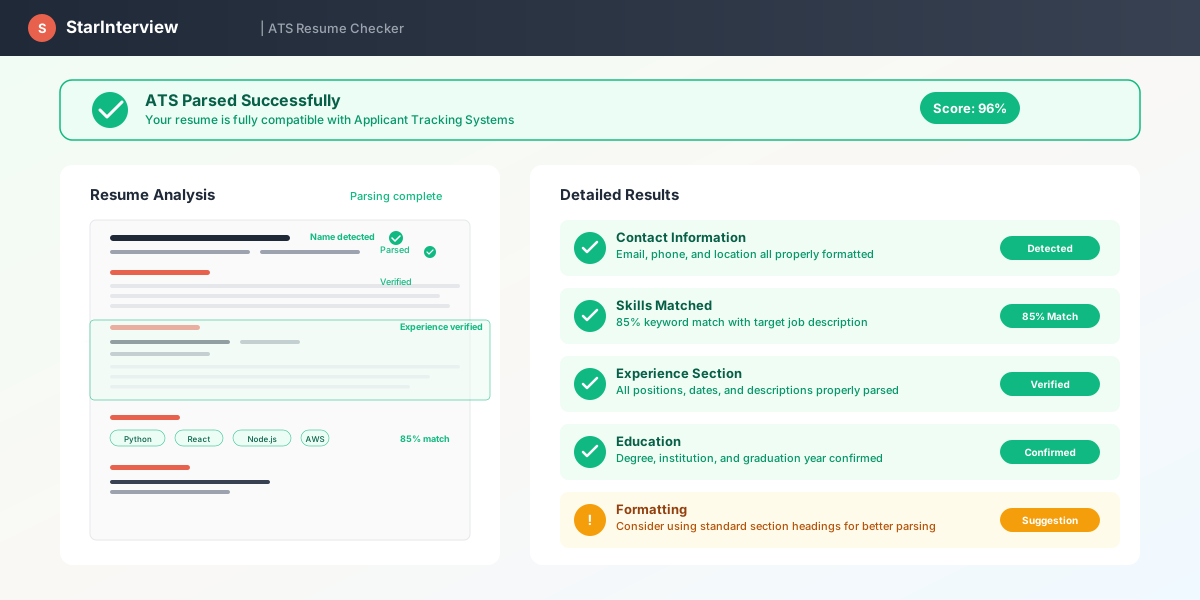
Here are the critical ATS formatting rules for entry-level resumes.
Use a single-column layout. Multi-column layouts, sidebars, and text boxes confuse ATS parsers. Stick to a clean, single-column format with clear visual hierarchy created through headings, bold text, and spacing.
Use standard section headers. “Education,” “Skills,” “Projects,” “Experience,” “Activities” — these are the headers ATS software recognizes. Creative headers like “My Journey” or “What I Bring to the Table” may look clever, but they will not be parsed correctly.
Submit as PDF or .docx. These formats preserve your formatting and are universally supported by ATS software. Avoid .pages, .jpg, or other formats that some systems cannot read.
Avoid graphics, tables, and columns. Icons, progress bars, charts, and table-based layouts may look modern, but most ATS software cannot parse them. Your contact information should be plain text, not embedded in a header graphic. Use our free ATS-optimized resume templates to ensure your resume passes the machine screen before it reaches human eyes.
Step 8: Use AI to Polish and Optimize
Once you have drafted your resume, AI tools can take it from good to great. AI resume generators analyze your content against the target job description, identify missing keywords, suggest stronger action verbs, and optimize your formatting for ATS compatibility. For entry-level candidates, this optimization is especially valuable because you cannot afford to lose opportunities to formatting issues or keyword gaps.
Paste your draft and the job description into an AI tool. The AI will suggest reordering sections for impact, replacing weak language with stronger alternatives, and adding keywords that match what the employer is looking for. It will also flag generic phrases that should be more specific and suggest quantified alternatives.
Our AI resume generator is built for this exact workflow. It includes an ATS compatibility score, keyword matching analysis, and tailored suggestions for each job description. It is free to try, and the improvements are measurable — most users see their ATS score jump from the 60% range to above 90% after optimization. If you want to understand the full AI resume workflow, read our guide to AI resume writing.

Common Mistakes to Avoid on Your First Resume
Knowing what not to do is just as important as knowing what to do. These are the most common mistakes entry-level candidates make — and how to avoid each one.
Apologizing for lack of experience. Never write phrases like “although I have limited experience” or “while I have not yet had the opportunity to work professionally.” Your resume should project confidence, not apology. Focus on what you do have, not what you lack.
Using an objective that says nothing. “Seeking a challenging position that allows me to grow professionally” is wasted space. Every candidate wants that. Your objective should name the specific role and highlight your top qualification.
Listing every course you ever took. Relevant coursework is valuable; a complete transcript is not. Pick four to six courses that directly connect to the job requirements. “Introduction to Psychology” does not belong on a software engineering resume.
Including irrelevant personal information. Age, marital status, photo (in the US), religious affiliation, and political views do not belong on a resume. In some countries this is standard, but for US-based applications, keep it professional and focused on qualifications.
Sending the same resume to every job. Tailoring your resume for each application is not optional — it is the single most effective thing you can do. Even small adjustments to your summary, skills order, and project emphasis can dramatically increase your callback rate. A generic resume signals a generic candidate.
Typos and formatting inconsistencies. One typo can disqualify you. Proofread multiple times, use spell check, and ask someone else to review your resume before submitting. Inconsistent formatting — different bullet styles, uneven spacing, mixed date formats — signals carelessness.
Example: Entry-Level Resume Before and After
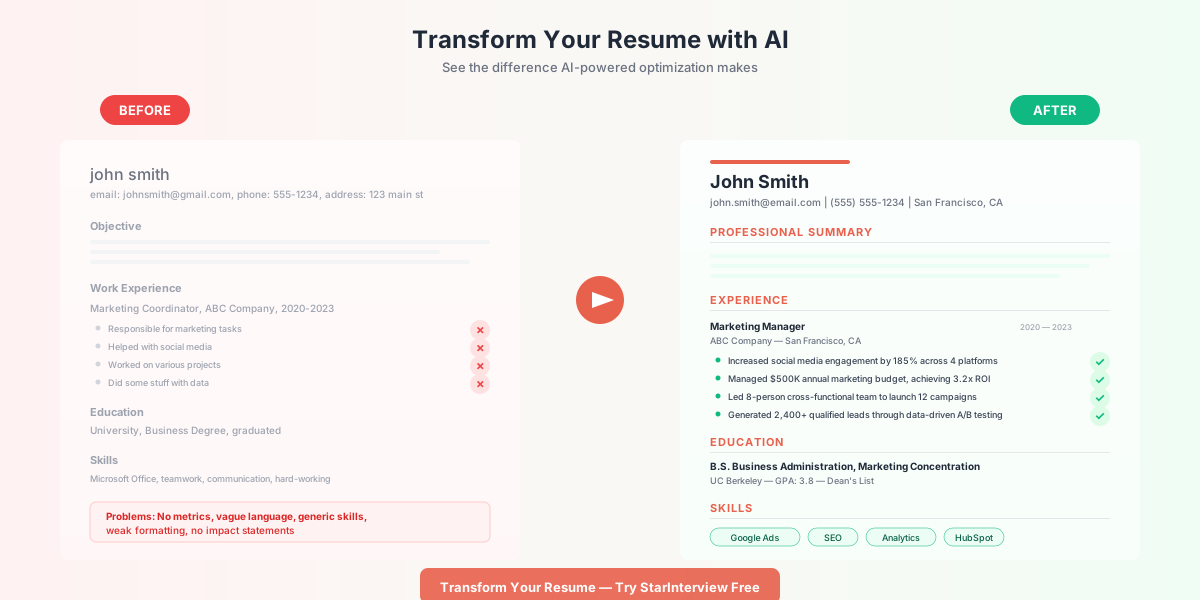
Let us see these principles in action. Here is a before-and-after comparison of a real section from a fresh graduate's resume.
Before (Weak)
Education
State University, 2026
B.S. Computer Science
Projects
Built a website for a class.
Made an app with some friends for a hackathon.
Skills
Python, Java, teamwork, communication, hard worker
After (Strong)
Education
State University — B.S. Computer Science, May 2026
GPA: 3.7/4.0 | Dean's List (4 semesters)
Relevant Coursework: Data Structures, Algorithms, Software Engineering, Database Systems, Machine Learning
Projects
TaskFlow — Full-Stack Task Management App | React, Node.js, PostgreSQL
• Designed and built a web application serving 50+ beta users with real-time collaboration features
• Implemented JWT authentication and RESTful API with 15 endpoints, achieving 99.5% uptime over 3 months
• DevTrack — HackMIT 2025 | Python, Flask, Chart.js
• Led a 4-person team to build a developer productivity dashboard in 36 hours, placing 3rd out of 120 teams
• Integrated GitHub API to visualize commit patterns and code review metrics for open-source repositories
• Presented to a panel of 5 judges from Google and Stripe, receiving the “Best Data Visualization” award
Skills
Languages: Python, Java, JavaScript/TypeScript, SQL | Frameworks: React, Node.js, Flask | Tools: Git, Docker, PostgreSQL, AWS (S3, EC2) | Certifications: AWS Cloud Practitioner
The “after” version takes the same candidate and the same raw material and turns it into a compelling narrative. Specific technologies, quantified outcomes, action verbs, and clear structure transform a forgettable resume into one that earns interviews. Every entry-level candidate has enough material for this level of detail — you just need to frame it correctly.
Ready to Build Your First Resume?
Use our AI-powered resume generator to turn your education, projects, and skills into an ATS-optimized resume that gets interviews. Free to try — no experience required.
Build Your Resume Free →Frequently Asked Questions
Can I get a job with no experience and no degree?
Yes. Many employers in 2026 value skills, projects, and demonstrated ability over formal credentials. Focus your resume on transferable skills, personal projects, certifications, and volunteer work. Bootcamps, online courses, and self-taught skills are increasingly recognized by hiring managers. The key is showing what you can do, not just listing what you have studied.
What should I put on my resume if I have never worked before?
Lead with your education, relevant coursework, and academic achievements. Add a projects section showcasing class assignments, personal projects, hackathon entries, or open-source contributions. Include volunteer work, extracurricular activities, and leadership roles. List technical and soft skills with specific examples. Even without formal employment, you have more to show than you think — framing and structure make the difference.
How long should a resume be for someone with no experience?
One page. Always one page for entry-level candidates. A single, well-organized page forces you to prioritize the most relevant information and makes life easier for recruiters who spend an average of six to seven seconds on an initial resume scan. If you are struggling to fill one page, you are not highlighting enough of your projects, skills, and extracurricular involvement.
Should I include a resume objective or summary with no experience?
Yes, but make it specific. A generic objective like "seeking an entry-level position where I can grow" adds nothing. Instead, write a targeted summary that names the role you want, highlights your strongest qualification (a degree, a certification, a project), and states the value you bring. For example: "Computer science graduate with hands-on experience building full-stack applications through academic and personal projects, seeking a junior developer role to apply strong problem-solving skills and React expertise."
How do I make my resume pass ATS if I have limited content?
Use a clean, single-column layout with standard section headers (Education, Skills, Projects, Experience). Mirror keywords from the job description in your skills and project descriptions. Avoid tables, graphics, headers/footers, and unusual fonts that confuse ATS parsers. Use our free ATS-friendly resume templates as a starting point, then run your resume through an ATS compatibility checker before submitting.
Related Guides
- AI Resume Generator: Build an ATS-Optimized Resume in Minutes
- Free ATS-Friendly Resume Templates for Every Industry
- AI Cover Letter Generator: Tailored Cover Letters in Minutes
- How AI Can Write a Better Resume Than You (And Why That's OK)
- How to Write a Cover Letter That Gets You Hired (2026 Guide)
- Behavioral Interview Questions and Answers: STAR Method Guide
- Practice Mock Interviews With AI Feedback