Review · Interview Anxiety
Your Mind Goes Blank in Interviews. I Tested 5 Fixes — Here's What Actually Worked
You solved this exact problem last week. Now someone is watching, there's a timer, and your head is empty. This is not a knowledge problem, and grinding more LeetCode will not fix it. I spent two weeks testing five fixes, three mock sessions a week, tracking every blank. Here's what worked, what the research says, and a day-by-day plan you can copy.
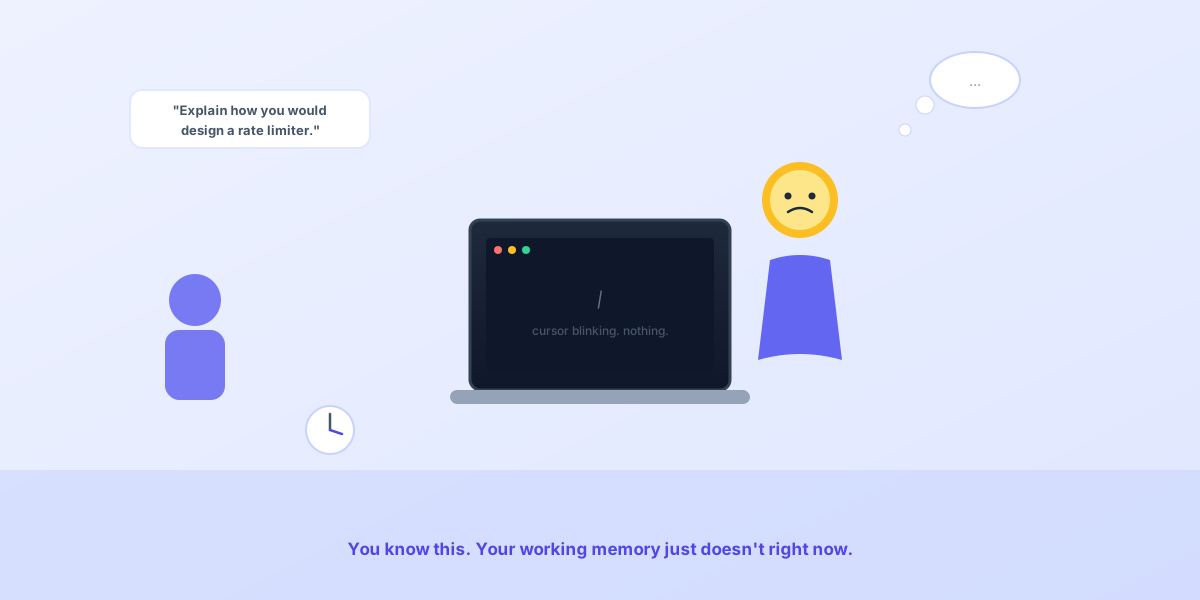
What blanking actually is
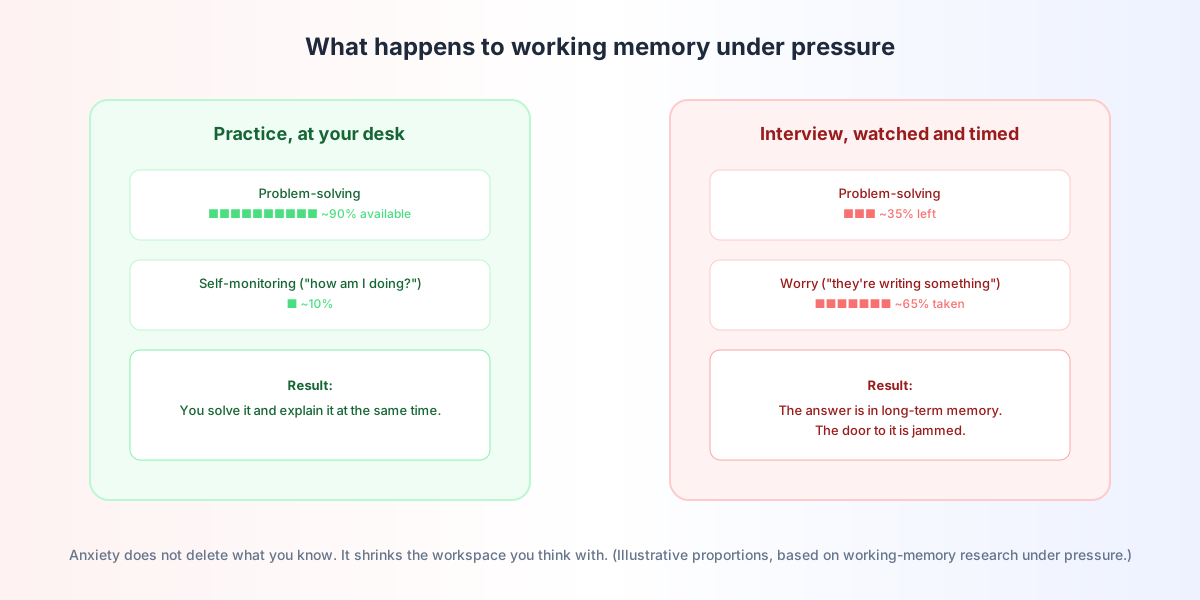
The short version: pressure shrinks working memory — the mental workspace you use to hold a problem and talk through it at the same time. Your facts live in long-term memory and they're fine. But to use them you have to pull them through working memory while also tracking the question, the interviewer's face, and the clock. When worry thoughts take up that workspace, there's not enough left for the answer.
The research here is older than you'd think. Sian Beilock and Thomas Carr published the key study in Psychological Science in 2005. They put people under performance pressure (money, an audience, being recorded) during math problems and found something odd: the people hurt most by pressure were the ones with the highest working memory. Pressure didn't hurt the weakest performers — it pulled the strongest ones down toward everyone else. The people who blank are usually the people who normally don't need to think hard to think well.
This explains the part that bothers people the most: you can answer the question perfectly five minutes after the call ends. The knowledge didn't leave. The doorway to it was jammed.
How I tested the fixes
Two weeks, three 45-minute mock interview sessions per week, six sessions total per fix where timing allowed. I logged every blank — the question, how long the freeze lasted, and what (if anything) pulled me out. Not a lab study: one person, self-scored. Where real published research exists for a fix, I've cited it and you should weight it above my sample size of one.
My baseline, week 1 with no fixes: three blanks in four sessions, average freeze around five seconds of dead air, one session where I abandoned an answer halfway through. If that sounds familiar, the rest of this is for you.
The five fixes, ranked
Scripted recovery phrases
My rating: 5/5 · Effort: 10 minutes to prepare
This is the cheapest fix and the one I'd suggest you do today, even if you have an interview tomorrow morning.
You prepare, word for word, two or three sentences that buy you time without making you look lost. Mine were:
"Good question — let me think about that for a second." (Then actually pause. Silence for 3-5 seconds reads as thinking, not failure.)
"Let me make sure I answer the right thing — you're asking about X, correct?" (Restating the question does two things: it confirms you listened, and it gives your brain a running start, because retrieval is easier when you've just said the relevant words out loud.)
"Let me start with the simple version and then refine it." (This is the brute-force move. A rough answer you can improve beats a perfect answer stuck in your head.)
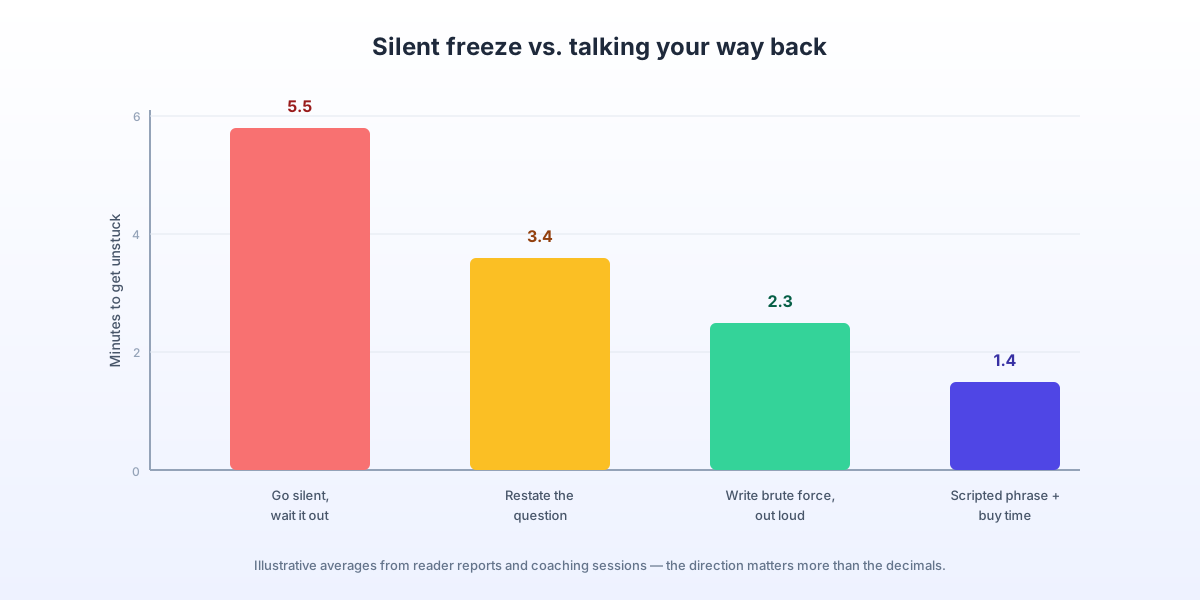
I rated this 5/5 for one reason: it worked in the moment, on the first try. In session 4 I blanked on a system design follow-up, said "let me make sure I answer the right thing," and the restatement pulled the answer up. Total cost: ten minutes of writing phrases on a sticky note and rehearsing them twice.
The failure mode: if you say the phrase and then keep sitting there silently, it doesn't help. The phrase buys 5 seconds. You still need to put something on the board.
Thinking out loud, forced
My rating: 4/5 · Effort: Uncomfortable for about a week
Everyone tells you to think out loud. Nobody tells you how weird it feels if you're a quiet thinker, and so most people try it once, feel ridiculous, and stop.
The version that worked for me had a rule: narrate garbage. "I'm considering a hash map here... no wait, the input is sorted, so two pointers might work." Saying the wrong thing out loud is the point. Interviewers give hints to people whose reasoning they can hear. They cannot help a person who is silent.
Two weeks of forced narration and it stopped requiring effort. My filler went from "um, let me think" to actual content: constraints, tradeoffs, why not the other approach.
Why 4/5 instead of 5: it takes about a week of consistent practice to stop feeling fake, and during that week you'll be tempted to quit. It also doesn't save you once you've already gone blank — it's prevention, not rescue. Pair it with fix 1.
Expressive writing before the interview
My rating: 4/5 · Effort: 10 minutes before each interview
This one sounds like something from a wellness blog, so I went looking for the actual evidence before trying it.
The study is real and it's better than most. Ramirez and Beilock, published in Science in 2011: students wrote for 10 minutes about their worries immediately before a high-pressure math test. The control group choked, dropping about 12% in accuracy from pre-test to post-test. The writing group improved about 5%. In the classroom field experiment, students who were habitually anxious and wrote before the exam outperformed controls by 6% on the final — close to a full grade point in their sample.
The mechanism matters: writing about the worry, specifically. Writing a to-do list or a summary of your skills didn't show the same effect in the follow-up analyses. It's the act of dumping the specific anxious thoughts ("what if they think I'm slow", "I need this offer") onto paper so they stop running in a loop during the interview.
I did this before my mock sessions in week 2. Honest report: it felt silly, and I noticed no difference in how I felt walking in. But I blanked zero times in those sessions, versus three times in week 1. One person, no controls, so treat that as a data point and not a study. The published evidence is why I still rate it 4/5 despite the silliness factor.
Retrieval practice, out loud, spaced
My rating: 4/5 · Effort: 20-30 minutes a day
Here's the uncomfortable finding from the learning science: rereading and re-watching feel productive and do almost nothing. Testing yourself — closing the book and forcing the answer out of memory — is what builds the kind of knowledge that survives pressure. This is the testing effect, and it's one of the most replicated results in memory research (Roediger and Karpicke's 2006 study is the classic; participants who tested themselves retained roughly 50% more a week later than participants who restudied).
The interview-specific version: don't review your behavioral stories by reading them. Close the document and tell them out loud, badly, in your own words, then check what you missed. Do the same for technical explanations — describe how a hash map handles collisions out loud, to an empty room, without notes.
It's slower and it feels worse than rereading. That friction is the signal that retrieval is happening. Spacing matters too: 20 minutes daily for a week beats one 3-hour weekend block, because sleep between sessions is when the retrieval paths get reinforced.
Why 4/5: it builds the underlying capacity, but it takes days to weeks. It's the long-term fix, not the day-before fix.
Mock reps under observation
My rating: 5/5 · Effort: Highest — needs scheduling
All four fixes above are half-measures without this one. Blanking is situation-specific: your nervous system treats "person watching me, timer running, stakes real" as a different situation from "me at my desk," and it responds differently to it. The only way to make the interview setting boring is to repeat the interview setting.
The research analogy is stress exposure training: rehearse the skill under conditions that resemble the performance environment, and the environment stops being the problem. For interviews, that means timed sessions, out loud, with someone or something on the other end evaluating you.
My schedule was three mocks a week for two weeks, 45 minutes each. By session 5 or 6, something shifted: the questions still required thought, but the physical panic — racing heart, empty head — showed up weaker each time, and by week 2 it mostly didn't show up at all. The blanking episodes went from three in my first four sessions to zero in my last six.
The failure mode is obvious: scheduling. Peer mocks fall through, human coaches cost $150+ an hour. AI practice solved the volume problem for me — I could do a session at 11pm without coordinating with anyone. That's the one place I'll plug our own tool: you can run a full timed mock interview here, free, and it works fine at 11pm. Whether you use us, a friend, or Pramp doesn't matter. The reps do.
Results at a glance
| Fix | Works how fast | Blanks (week 2) | Rating |
|---|---|---|---|
| Scripted recovery phrases | Same day | 0 fatal, 1 caught early | 5/5 |
| Thinking out loud, forced | ~1 week | 1 brief | 4/5 |
| Expressive writing before | Same session | 0 | 4/5 |
| Retrieval practice, out loud | Days to weeks | 1 brief | 4/5 |
| Mock reps under observation | 5-6 sessions | 0 | 5/5 |
Self-reported, one test subject. The published studies cited above carry more weight than my two weeks.
The 7-day plan I'd give a friend
If your interview is next week, do this. It stacks all five fixes in the order that makes sense: the fast rescues first, the slow capacity-building underneath.
- Day 1: Write your three recovery phrases. Say each out loud five times until they sound like you, not like a script. Test yourself on your best story: close your notes, tell it out loud, check what you missed.
- Day 2: First timed mock, 45 minutes. Narrate everything, including wrong turns. Expect it to feel bad. That's the exposure working.
- Day 3: Retrieval only, no rereading. Stories and technical explanations, out loud, from memory. 20 minutes is enough if it's honest.
- Day 4: Second mock. Ten minutes of expressive writing first — the actual worries, on paper, then throw the paper away.
- Day 5: Rest or light review. Sleep is part of the training; retrieval paths consolidate overnight.
- Day 6: Third mock. Full dress rehearsal: same time of day as the real one if possible, same setup.
- Day 7 (day before): No cramming. Read your recovery phrases once. Early night.
One tool note for the behavioral half of this: the fastest way to build your story bank is to generate structured answers from your own experience and then rehearse them with the notes closed — the tool gives you the raw structure in minutes, and the retrieval practice is what makes it survive pressure.
Related guides
How to Prepare for a Technical Interview
The full 7-step prep plan: process, patterns, system design, behavioral, mocks.
Common Interview Mistakes
The mistakes that get candidates rejected before the technical rounds even start.
Tech Interview Preparation
End-to-end prep strategy for the big companies, round by round.
Behavioral Interview Guide
The STAR method in depth, with examples from real interviews.
Make the interview setting boring
Blanking fades with reps under realistic conditions. Run a timed mock, get feedback on where you went quiet, repeat. Free to start.
Run a Free Mock Interview →Frequently asked questions
Why does my mind go blank in interviews even when I know the material?
Pressure shrinks your working memory — the mental workspace you use to hold a problem and talk through it at the same time. A 2005 study by Beilock and Carr (Psychological Science) found that people with high working memory capacity were the ones hurt most by performance pressure, because worry thoughts consume exactly the resources they rely on. The knowledge is still in long-term memory. The route to it is just crowded. This is why blanking feels so strange: you can answer the same question perfectly five minutes after the call ends.
What should I say when my mind goes blank mid-answer?
Use a prepared line, something like: "Give me a second to organize that — I want to answer it properly." Then do one concrete thing: restate the question in your own words, or start with the simplest version of the answer and build. Never go silent for long. Interviewers consistently say that a candidate who visibly recovers scores better than one who freezes quietly, because recovery is a skill they want on the job too.
Does writing down my worries before an interview really help?
There is decent evidence for it. In a 2011 study published in Science, Ramirez and Beilock had students write for 10 minutes about their worries right before a high-pressure exam. The control group choked, dropping about 12% in accuracy, while the writing group improved about 5%. In the field experiment, highly anxious students who wrote before the final exam outperformed controls by 6%. The mechanism: getting worries onto paper stops them from looping in your head and eating working memory during the test itself.
How many mock interviews do I need before blanking stops?
Most people need somewhere between 8 and 15 timed, observed sessions before the interview setting stops feeling like an emergency. The number matters less than the conditions: you need a timer, you need to speak out loud, and ideally you need some form of evaluation. Solving 50 problems silently at your desk does not count — the whole problem is that your desk and an interview are different situations for your nervous system.
Is blanking a sign I'm not good enough for the job?
No, and the research says almost the opposite. Beilock and Carr found that pressure hurt the people with the most working memory — in other words, the people who normally perform best. Blanking means your stakes are high and your exposure is low, not that your skills are missing. Fix the exposure with practice under realistic conditions and the blanking almost always fades.