Self-Awareness
Interview Questions About Weaknesses — and How to Answer Each One
The quick answer: Interview questions about weaknesses — “What is your biggest weakness?”, “What would your worst critic say?”, “What feedback did your manager give you?” — all grade the same three things: candor, self-awareness, and evidence you actually change. Answer with one real (non-critical) weakness, a specific moment it cost you something, and the fix you can already show proof of. Never “perfectionist.”
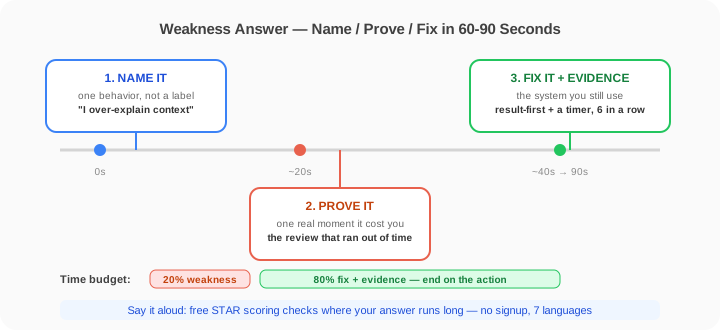
“What is your biggest weakness?” almost never arrives alone. Interviewers circle the same trait — self-awareness with a track record of change — through seven differently-worded questions. This page maps all seven phrasings (pulled from real search suggestions), gives an example answer shape for each, and shows what interviewers write down when your answer is evasive.
Why Interviewers Ask This
The weakness question measures emotional intelligence, not the skill itself. Interviewers listen for three green flags: you name a real limitation with a concrete cost, you explain how the fix works (not just that you took a course), and you can project the next step honestly. Red flags: disguised strengths (“I work too hard”), a weakness that is core to the job you're applying for, or “I can't think of one.”
The 7 Phrasings of This Question
Different wording, same scorecard — prepare one story and let these openers point at it.
“What is your biggest weakness?”
The classic — one weakness, deep fix. Covers 80% of panels.
“What are your weaknesses?”
Plural probe — two max. Pair one skill gap with one behavioral one.
“What would your worst critic say about you?”
Same rubric, borrowed self-awareness — quote real feedback if you have it.
“What feedback has a previous manager given you?”
Expect a follow-up: what did you DO with it? Bring the mechanism.
“What's one thing you'd change about yourself?”
Softer framing — answer with a work behavior, not a personality confession.
“What are your strengths and weaknesses?”
Balance test — keep both answers story-shaped, not adjective lists.
“Tell me about a skill you're still developing”
Growth-mindedness probe — show the learning curve is active, not performed.
STAR Method Sample Answers
The S/T/A/R blocks below are labeled Name / Prove / Fix / Evidence — the weakness answer is still STAR, just pointed backward at a flaw instead of forward at a win. Each sample covers a different phrasing from the question family.
The classic: “What is your biggest weakness?”
Name it as a behavior, not a label: “I used to over-explain context before getting to the point. My manager told me three status updates in a row ran long enough that people stopped asking follow-ups.”
Prove it with one real cost: “In a leadership review my rambling ate the Q&A slot, and I was told the decision got deferred because there was no time to discuss risks.”
Fix it with a mechanism, not a feeling: “I started leading with the result in one sentence and adding detail only if asked. I timed myself before big meetings and asked a colleague to interrupt me at the 40-second mark.”
Land on evidence that's ongoing: “My last six reviews all ended with time for questions. It's a habit I still check — old me would have answered this question with ‘I'm a perfectionist.’”
The reframe: “What would your worst critic say about you?”
Same answer engine, different fuel: pick feedback you actually received. “My worst critic — my old tech lead — would say I hoard work instead of delegating.”
Show the cost it created: “She was right: I kept a migration report to myself and shipped it two days late while two teammates had spare capacity.”
Name the specific system change: “Now I split every project into tasks on day one and assign at least half before I start.”
Proof + still-managing honesty: “The last two reports went out early, and one teammate now owns the data section entirely. I still catch myself re-doing their work — that's the part I'm on watch.”
The freshers version: “What's a weakness if you have no work experience?”
Use school, volunteer, or side-project settings — the rubric doesn't require paid work. “In my capstone team I agreed to own three components because saying no felt like letting people down.”
One concrete cost: “All three came in at 70% — the presentation suffered most because I couldn't explain the integration decisions.”
The behavior change you made: “Since then I write down my commitments in one list and check it before accepting anything new. My club advisor started using the same list format with the team.”
Small verifiable proof: “My next project: I kept two components, delivered both fully, and flagged the third risk a week early so someone else could take it on time.”
Tips for Your Answer
- ✓Pick a real weakness that is NOT a core requirement of the role — public-speaking anxiety is fine for an analyst, fatal for a sales rep.
- ✓Name a behavior (“I lose track of follow-ups when I juggle five projects”), not a personality label (“I'm disorganized”).
- ✓Spend 20% on the weakness, 80% on the fix and its evidence — end on the action, not the problem.
- ✓“Still working on it” beats “fixed forever” — a managed weakness is more believable than a cured one.
- ✓Say the answer out loud against a timer: written weakness answers run 3+ minutes spoken, panels cut you off at question two.
Common Mistakes
- ✕The humble-brag: “I'm a perfectionist” / “I work too hard” — interviewers flag it as evasive in the first three words.
- ✕“I don't have any weaknesses” — reads as zero self-awareness, the exact trait the question measures.
- ✕Confessing a deal-breaker for the job (“I hate numbers” for an analyst role) — honesty with no judgment.
- ✕Listing a weakness with no cost story — sounds invented, invites the follow-up that buries you.
- ✕Naming a course you took as the whole fix — interviewers want the mechanism you still use, not a certificate.
Weak-Answer Red Flag Table — What Interviewers Write Down
Three answers that look safe but trigger the same note on a scorecard, with the swap that keeps your story and drops the flag.
✕ Weak answer
“My biggest weakness is that I care too much about quality.”
🚩 Their note
Disguised strength — the interviewer writes down “avoids the question.” Candor failed before the story even started.
✓ The swap
Swap to a plain behavior with a price tag: “I over-polish deliverables and have missed internal deadlines doing it. I now timebox revision rounds.”
✕ Weak answer
“I sometimes take on too much because everyone asks me.”
🚩 Their note
Blame-shaped weakness — reads as “victim of my own competence.” Same red flag, different mask.
✓ The swap
Own the decision: “I commit before checking my workload. Fix: I ask for scope and deadlines, then answer after I look at my calendar — even when it's awkward in the moment.”
✕ Weak answer
“I'm just not a natural public speaker.”
🚩 Their note
Fixed-ability framing — implies you won't improve. For a role with client presentations, it's a double red flag.
✓ The swap
Show movement: “I was. I volunteered for the monthly demo and practiced each talk aloud twice before presenting; three talks in, a client told me the roadmap walkthrough was the clearest part of the call.”
FAQ
How do you answer your biggest weakness in an interview?↓
Three parts in 60-90 seconds: Name it — one real behavior, not a label. Prove it — the one moment it cost you something. Fix it — the system you changed plus evidence it's working. End on the fix, keep the weakness at 20% of the answer.
What are your weaknesses best answer examples?↓
Safe-but-real picks: over-explaining context, difficulty delegating, agreeing to work before checking bandwidth, over-polishing past deadlines, slow to ask for help. Any of these works IF paired with one specific cost and one mechanism you now use. Skip personality confessions (temper, laziness) and skill gaps the job requires.
Can I say perfectionist as my weakness?↓
No — it's the most cited example of a disguised strength and interviewers hear it constantly. If perfectionism genuinely costs you something, name the behavior instead: “I spend too long on first drafts until the format is flawless, so I timebox revision rounds now.” Same truth, no red flag.
What weakness should I avoid mentioning in an interview?↓
Three categories: anything core to the role (detail-obsession for an editor, avoiding calls for a sales rep), anything about reliability or integrity (lateness, dishonesty, conflict with managers in general), and anything framed as unchangeable. If a weakness is real but risky, find the version that shows you manage it.
How many weaknesses should I prepare for an interview?↓
One deep, fully-proven weakness answer covers every phrasing — “biggest weakness,” “worst critic,” “manager feedback,” “areas to improve” all grade the same self-awareness. Build one story with cost + fix + evidence, then rehearse it against three different openings so it adapts without sounding scripted.
What if the interviewer pushes back on my weakness answer?↓
Follow-ups are the real test: “How does that still affect you?” / “What made the fix work?” / “What support would you need from us?” Have the mechanism ready (what exactly you changed and why it holds) and the honest edge (what still slips). If you can't answer follow-ups, your first answer was a script, not a story.
How can I practice the weakness question out loud for free?↓
StarInterview's practice tool scores spoken answers on each STAR dimension — Situation, Task, Action, Result separately — free, no signup, works in 7 languages. Say your weakness answer aloud and watch where it runs long or loses the Result: that's exactly what an interviewer clocks.
Practice this question with AI
Get instant feedback on your STAR method answer. Free, no signup.
Start Practicing →