By Role
Behavioral Interview Questions for Nurses — and How to Answer Them with STAR
The quick answer: Behavioral interview questions for nurses ask for real stories: a difficult patient, a safety risk you flagged, a conflict on the unit, a mistake you owned. Answer each in STAR shape — one short Situation, your Task, 2-3 Actions starting with 'I', and a Result a charge nurse would believe. New grads: clinicals, simulation, and volunteer shifts count as sources.
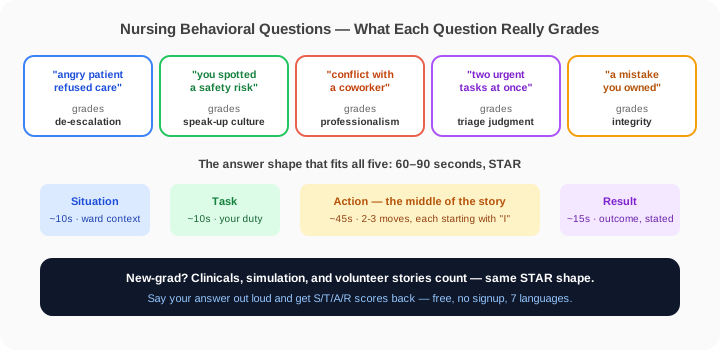
Most hospital interview panels run on behavioral questions — they want evidence of how you acted, not how you'd say you'd act. The good news: every question on their list maps to one of five things they're grading (patient advocacy, safety speak-up, teamwork under stress, prioritization, integrity). Prepare 6-8 real shift stories and you can answer almost anything they ask.
Why Interviewers Ask These Questions
- 1Nursing judgment under pressure is hard to fake — past behavior on a real unit is the best predictor.
- 2Hospitals grade patient safety and speak-up culture heavily after incident reviews; they need proof you'll escalate.
- 3Interview panels are usually the charge nurses and nurse managers you'd work with — they're picturing you on their unit.
- 4New grads and internal transfers get the same rubric: the story's shape matters more than the setting.
7 Interview Questions with STAR Answers
Tell me about a time you dealt with an angry or uncooperative patient.
A patient on my evening shift refused his blood pressure medication and was shouting that no one was listening to him.
As his assigned nurse, I needed to get his vitals managed without escalating the confrontation or forcing the med.
I pulled a chair to his eye level, let him vent without interrupting, then repeated back his two actual complaints — the noise and waiting for rounds. I explained what the medication was protecting him from, offered him the choice of timing within my med pass window, and looped in his daughter on speaker so he wasn't deciding alone.
He took the medication 20 minutes later and apologized before shift end. His BP trended down over the next two days, and the charge nurse started using the 'chair at eye level' approach with other agitated patients.
💡 Tips for this answer
- •Interviewers listen for de-escalation, not bravado — no restraint-first stories.
- •Name what you did, not what 'we' did — assigned care is yours.
- •Close with the patient's outcome, not just that they calmed down.
Describe a time you noticed a safety issue or a colleague cutting corners. What did you do?
During med administration I noticed a colleague scanning a different patient's wristband while pulling a high-alert anticoagulant dose.
I had to stop a potential wrong-patient dose without turning it into a public call-out in front of the family in the next bed.
I said a neutral 'let me double-check that one with you' and re-scanned together — the band matched, the order was right, but the near-miss was real. After the pass I walked her to the med room, described what I'd seen without accusation, and we both flagged the distraction hotspot (shared printer next to the crash cart) to the manager as a unit issue, not a person issue.
The printer was relocated the following week. My manager noted the pair-check habit in our huddle, and nothing like it recurred on our team that quarter.
💡 Tips for this answer
- •This is their #1 speak-up culture probe — hesitate-but-act beats heroics.
- •Show you separated the person from the system; blameless framing signals maturity.
- •A concrete system change as the Result is gold — it proves your escalation landed.
Tell me about a time you had a conflict with a coworker or doctor.
A hospitalist kept overriding my pain-management plan for a post-op patient without discussing it with me, and the patient was telling me he felt ignored.
I needed the care plan to stay consistent for the patient without burning a relationship I'd see every day for the rest of the rotation.
I collected two rounds of vitals and pain scores, then asked for five minutes at the nurses' station before rounds — not in front of the team. I framed it as 'help me understand your reasoning' rather than a challenge, discovered he was guarding a renal issue I hadn't seen flagged, and we agreed on a joint plan I communicated to the patient myself.
The patient's pain scores came down that night and he thanked me for 'finally explaining things.' The hospitalist and I co-signed that adjusted order set for similar cases the next month.
💡 Tips for this answer
- •Never trash the other person — panels ask your references the same question.
- •Show you moved it out of the patient's earshot; that's a professionalism check.
- •'Help me understand' beats 'you're wrong' — interviewers hear the difference.
Give me an example of when you had to prioritize multiple urgent tasks at once.
At the start of my shift I had one patient on oxygen desaturating into the high 80s, a family pressing me about discharge paperwork, and an IV pump alarm down the hall.
I had to sequence the three so nothing became a harm event while the clock was running.
I went to the desaturating patient first and sat with him to escalate his positioning and oxygen, called my CNA to silence and assess the pump alarm one room over, and told the family member honestly I'd be at the bedside in ten minutes — then handed the paperwork to the charge nurse to start while I finished assessments. I closed the loop with the family after, not before.
His sats were stable at 94 within fifteen minutes, the pump was an occlusion alarm cleared quickly, and the discharge still went out that afternoon. My charge nurse said the explicit hand-off was what kept it from becoming two delays.
💡 Tips for this answer
- •State your triage logic out loud — clinical judgment IS the answer.
- •Asking for help is a scoring plus, not a weakness, if you say who you asked and why.
- •End with everyone getting a real update; communication is half of prioritization.
Tell me about a mistake you made in patient care. How did you handle it?
Early in my first RN job I charted a vital sign for the wrong patient row — the values were mine but the patient wasn't.
I had to correct the record honestly before it influenced anyone else's decisions, and own it with my manager.
I flagged it to the charge nurse within the same shift, filed the late entry correction per policy, and told my manager in our next huddle before she saw it in an audit. Then I built a two-identifier habit — saying the patient's last name against the badge band out loud before charting anything — and asked a teammate to spot-check me for a week.
The correction was clean and no one acted on the wrong data. My manager wrote it up as the unit's example of self-reporting, and the read-aloud habit caught a second mismatch on a different shift two weeks later.
💡 Tips for this answer
- •Choose a real, non-harmful mistake — panels forgive errors, they don't forgive hiding them.
- •The same-shift disclosure timeline is the detail that sells integrity.
- •End with a behavior change you still use, not a lesson learned in the abstract.
Describe a time you had to advocate for a patient when no one else was.
An elderly patient scheduled for a discharge kept saying 'they're sending me home too soon,' but her care team was focused on bed flow.
I needed her concern taken seriously without delaying legitimately ready patients or being dismissive of the plan myself.
I did a quick home-safety check-in with her daughter by phone, documented her three falls at home, and brought the specifics to the discharge huddle instead of repeating 'she's anxious.' That changed the conversation from opinions to criteria — the team arranged home PT and a med-review visit before discharge.
She went home a day later with support in place and no ER bounce-back in the 30-day follow-up call. The case got brought up at the next unit meeting as a check-before-discharge example.
💡 Tips for this answer
- •Advocacy = data + the right room, not volume; show you converted a complaint into criteria.
- •Documenting first is a detail nurse managers clock immediately.
- •Name the follow-through (home PT, callback), not just the argument you won.
Tell me about a time you had to learn something new fast — a new system, unit, or skill.
When my med-surg unit switched to a new EHR documentation system, I was the only night-shift nurse with zero prior exposure and a full assignment on day one.
I needed to hit charting standards immediately without slowing the morning handoff for the day team.
I spent my last hour of precepting time shadowing the super-user rather than finishing my own rounds prep, wrote a two-page cheat sheet of just the flows I used at night (assessment, mar, I&O), and asked the super-user to quiz me at report time that week. I also flagged one confusing drop-down label she then escalated to training.
I was charting at normal speed by my third shift, my cheat sheet got copied to two other night nurses, and the drop-down fix went out in the next training patch.
💡 Tips for this answer
- •Nurse managers read this as coachability — show you asked for feedback, not just practiced.
- •Small unit-level wins (quiz at report, cheat sheet sharing) signal team lift.
- •New grads: simulation labs, skills check-offs, and a float rotation all qualify.
Common Mistakes to Avoid
- ✕Answering with hypotheticals ('I would always...') instead of a shift you actually worked.
- ✕Making the story about the team — panels are hiring you, name your own moves.
- ✕Ending on feelings ('it felt good') with no observable patient or unit outcome.
- ✕Picking a 'humble brag' mistake story instead of a real error you owned.
- ✕Running 3+ minutes on one answer — nursing panels cut off long setups on question two.
Frequently Asked Questions
How to answer nursing interview questions using STAR?↓
Keep Situation to one or two sentences of ward context, say your Task in first person, spend the middle 40-50 seconds on 2-3 Actions starting with 'I', and close with a Result a nurse manager would believe — a changed process, an outcome, a habit you kept. Aim for 60-90 seconds total.
What questions do they ask in a nursing interview?↓
Behavioral questions cluster into five grades: handling a difficult patient, flagging a safety risk, conflict with a coworker or doctor, prioritizing urgent tasks, and owning a mistake. Expect 'why this unit' and patient-advocacy questions as openers, and situational 'what would you do' hybrids on travel-nurse and med-surg panels.
How to prepare for a nursing interview?↓
Build 6-8 STAR stories from real shifts — including clinicals for new grads — then map each to the five competencies (safety, teamwork, advocacy, prioritization, integrity). Say at least five of them out loud against a timer, because written nursing stories almost always run long when spoken. Review the unit's patient population so your examples fit its acuity.
What is the best way to prepare for a nursing interview if I'm a new grad?↓
Use clinical rotations, simulation, and volunteer shifts as story sources — interviewers score the judgment shown, not the setting. One honest preceptored mistake you owned beats a flawless fake story every time. Practice out loud: new grads default to textbook answers that fit on paper but run 2+ minutes spoken.
Can I use stories from a different unit or specialty?↓
Yes — behavioral rubrics grade transferable judgment. An ER de-escalation answers an ICU teamwork probe, and clinic scheduling solves a prioritization question with re-framing. Translate the context in your first sentence so the panel sees why it applies, and keep clinical details accurate to the setting you describe.
What should I do if I don't have a conflict or mistake story?↓
You have more stories than you think: a coworker's charting habit that bothered you, a family disagreement about care, a preceptor correction. The mistake answer isn't optional — panels ask it precisely to test disclosure instincts. Pick a low-harm, same-shift-self-reported example rather than claiming perfection.
Do nurse practitioner and nurse manager interviews ask different behavioral questions?↓
Same STAR format, different focus. NP panels probe diagnostic reasoning, scope-boundary calls, and shared decision-making with patients. Nurse manager panels probe conflict between staff, coverage and scheduling trade-offs, and times you escalated up instead of around. Recut your stories toward the panel's stakes, not new stories.
How can I practice behavioral nursing answers out loud for free?↓
StarInterview's practice tool lets you speak each answer and get Situation, Task, Action, and Result scored separately — free, no signup, and it works in 7 languages, which helps if English isn't your first language and you interview in the US. Draft a story, say it aloud, fix the dimension that scores low, repeat.
Practice these questions with AI
Get instant feedback on your STAR method answers. Free, no signup.
Start Practicing →