Technical Guide
15 Essential System Design Interview Questions and Solutions (2026)
By Elara T · August 2026 · 16 min read
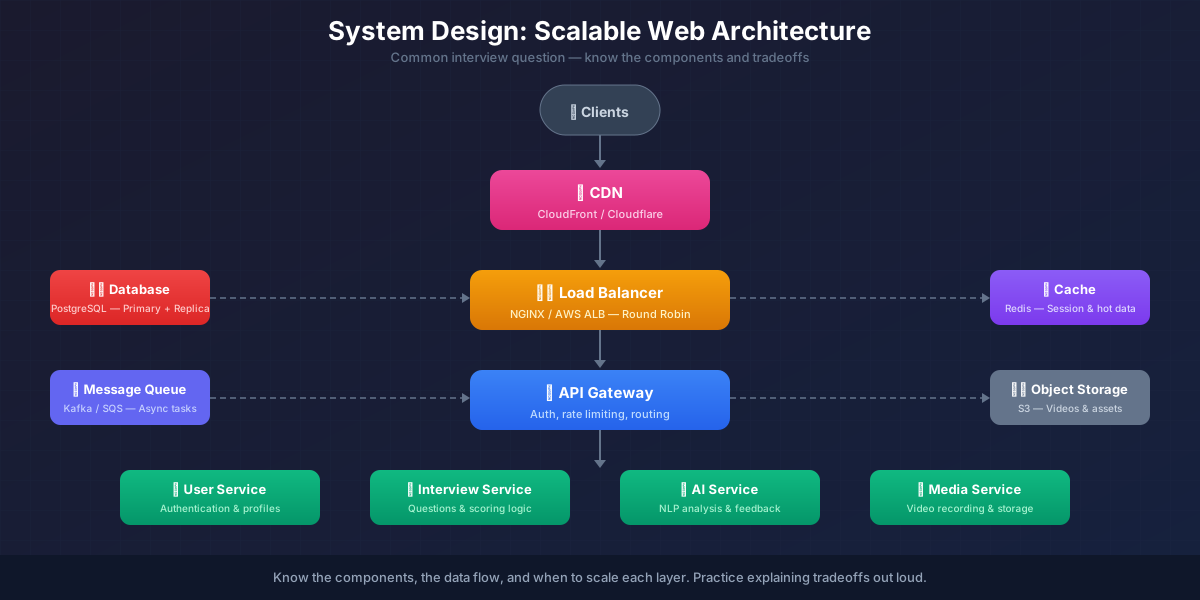
System design interviews are the most challenging and high-stakes component of technical hiring at top technology companies. Unlike coding interviews where there is often a single correct answer, system design questions are open-ended, ambiguous, and require you to make real engineering trade-offs under pressure. Candidates who excel at system design interviews demonstrate not just technical knowledge, but the ability to think holistically about scalability, reliability, and maintainability — skills that separate senior engineers from junior ones.
Whether you are preparing for a software engineer interview at a FAANG company or a startup, mastering these 15 system design questions will give you the foundation to tackle virtually any problem thrown at you. Each question below includes a structured approach, key components to discuss, and the critical trade-offs interviewers expect you to address. For hands-on practice with AI feedback, explore our system design interview guide or jump straight into practice sessions.
What Is a System Design Interview?
A system design interview is a technical evaluation where you are asked to architect a large-scale distributed system from scratch. The interviewer presents a broad problem — for example, "Design a URL shortener" or "Design Twitter" — and expects you to work through the problem collaboratively over 45–60 minutes. The goal is not to produce a perfect architecture, but to demonstrate your thought process, your ability to handle ambiguity, and your knowledge of distributed systems fundamentals.
System design interviews are typically reserved for mid-level and senior engineering roles, though increasingly they appear in entry-level loops at top companies. They test skills that coding interviews cannot: capacity estimation, technology selection, trade-off analysis, and the ability to design systems that operate at massive scale. Success requires both breadth of knowledge across infrastructure components and depth in critical areas like databases, caching, and networking.
The RESHADED Framework
Before diving into specific questions, let us introduce the RESHADED framework — a structured approach that ensures you cover every critical aspect of a system design problem. This framework keeps your answer organized and prevents you from missing important considerations under pressure.
- RRequirements — Clarify functional and non-functional requirements. Ask about scale, latency expectations, consistency needs, and user demographics before designing anything.
- EEstimation — Back-of-the-envelope calculations for traffic, storage, bandwidth, and memory. This grounds your design in real numbers and informs technology choices.
- SStorage — Choose data models, databases, and storage strategies. Decide between SQL, NoSQL, blob storage, and time-series databases based on access patterns.
- HHigh-level Design — Draw the major components, their interactions, and data flow. This is the blueprint that the rest of the interview builds upon.
- AAPI Design — Define the core APIs between clients and services. Specify endpoints, request/response formats, and authentication mechanisms.
- DDetailed Design — Deep dive into 2–3 critical components. Discuss specific algorithms, data structures, and implementation strategies.
- EEvaluation — Analyze your design against the original requirements. Identify bottlenecks, single points of failure, and capacity limits.
- DDrawbacks — Acknowledge trade-offs and limitations honestly. Discuss what you would change with more time or different constraints.
Using RESHADED consistently across your system design interview preparation will train you to approach any problem systematically, even one you have never seen before.
1. Design Twitter
Twitter's core challenge is handling asymmetric relationships — users follow others without requiring reciprocation — and generating personalized timelines at massive scale. The system must handle hundreds of millions of daily active users, billions of tweets, and extreme read-to-write ratios of roughly 1000:1.
Key Components: User service, tweet service, timeline service, fanout service, search service, and media service. The critical architectural decision is how to generate timelines: the fanout-on-write approach pre-computes timelines when a tweet is posted, storing them in each follower's timeline cache. This optimizes read performance but creates write amplification for celebrity accounts. The fanout-on-read approach merges timelines at read time, reducing write overhead but increasing latency. Twitter uses a hybrid: fanout-on-write for regular users and fanout-on-read for accounts with millions of followers.
Trade-offs: Storage cost vs. read latency, consistency vs. availability during high-traffic events, and real-time delivery vs. eventual consistency for timeline ordering.
2. Design a URL Shortener
A URL shortener converts long URLs into short, unique identifiers and redirects users when they access the short URL. The system must handle billions of URLs, support fast redirects with sub-50ms latency, and ensure globally unique short codes without collisions.
Key Components: A hash function generates the short code — either using MD5/SHA-256 with truncation (risking collisions) or a base-62 encoding of a unique counter. The recommended approach is a distributed ID generator (like Snowflake IDs) that produces 64-bit unique integers, then encodes them in base-62 to create 7–10 character codes. A relational database (with sharding by hash key) stores the mapping, with a Redis cache layer for hot URLs. The redirect service performs a cache lookup, then a database lookup, and issues a 301 or 302 redirect.
Trade-offs: 301 (permanent) vs. 302 (temporary) redirects affect caching and analytics. Custom aliases add complexity. Storage grows linearly but remains manageable with TTL-based expiration for unused links.
3. Design a Chat System
A real-time chat system must deliver messages with low latency, support one-on-one and group conversations, handle presence indicators (online/offline status), and ensure message delivery guarantees even when users go offline and reconnect.
Key Components: A WebSocket gateway maintains persistent connections with clients, enabling bidirectional real-time communication. The message service processes and routes messages, storing them in a message database (Cassandra or HBase for write-heavy workloads). A presence service tracks user status using heartbeats. For offline delivery, messages queue in a message store until the recipient reconnects. Group chats require a fanout mechanism — either fanout to all group members' inboxes or a shared message stream with per-user read pointers.
Trade-offs: WebSocket connections are stateful and resource-intensive, requiring sticky sessions or connection registries. Exactly-once delivery is expensive; most systems settle for at-least-once with client-side deduplication. End-to-end encryption adds latency but is expected in modern chat applications.
4. Design YouTube
YouTube is a video streaming platform that must handle video uploads, transcoding into multiple resolutions and formats, global content delivery, and serving billions of video streams daily with minimal buffering. The system is heavily read-dominated with a complex write pipeline.
Key Components: The upload pipeline accepts raw video, stores it in blob storage (S3/GCS), and triggers a transcoding service that converts video into multiple resolutions (360p, 720p, 1080p, 4K) and formats (H.264, VP9, AV1). A CDN distributes transcoded video globally — popular content is cached at edge locations close to users, while long-tail content uses regional origin servers. The recommendation service generates personalized feeds. Video metadata is stored in a relational database, while analytics (views, likes) flow through a streaming pipeline like Kafka.
Trade-offs: Transcoding quality vs. processing time and cost, storage cost vs. number of encoding profiles, and CDN cache hit rate vs. infrastructure cost. Adaptive bitrate streaming (HLS/DASH) improves user experience but increases complexity.
5. Design Uber
A ride-sharing platform must match riders with nearby drivers in real-time, estimate arrival times, calculate fares, and handle GPS location updates from millions of concurrent drivers — all while maintaining low latency for a responsive user experience.
Key Components: A location service ingests real-time GPS updates from drivers and indexes them using geospatial data structures like geohashes or quad-trees. The matching service finds available drivers within a radius of the rider, ranks them by ETA and rating, and assigns the ride. A trip service manages ride state (requested, matched, in-progress, completed). The ETA service uses historical traffic data and real-time conditions to predict arrival times. Pricing applies surge algorithms based on supply-demand ratios per geographic zone.
Trade-offs: Location update frequency vs. battery and bandwidth cost, ETA accuracy vs. computation cost, and surge pricing fairness vs. revenue optimization. Driver matching must balance speed with optimality — a globally optimal match is NP-hard, so greedy algorithms are used.
6. Design Dropbox
A file synchronization service must efficiently transfer files between devices, handle conflicts when multiple users edit the same file, support versioning, and minimize bandwidth usage — especially for large files with small changes.
Key Components: A chunking algorithm splits files into fixed-size blocks (typically 4MB) and computes hashes for each chunk. Only modified chunks are uploaded, enabling delta sync that dramatically reduces bandwidth. A metadata service tracks file hierarchies, versions, and chunk mappings in a relational database. The block storage service stores chunks in blob storage with deduplication — identical chunks across files are stored once. A notification service pushes sync events to connected clients via long polling or WebSocket. Conflict resolution uses "last writer wins" or saves conflicting versions for manual resolution.
Trade-offs: Chunk size affects deduplication granularity vs. metadata overhead. Consistency across devices requires careful ordering of operations. Offline editing creates complex merge scenarios that simple conflict resolution cannot always handle elegantly.
7. Design Google Search
A web search engine must crawl billions of web pages, build an inverted index for fast retrieval, rank results by relevance, and serve queries in under 200ms — all while the web constantly changes and grows.
Key Components: The crawler discovers and fetches web pages using BFS traversal, respecting robots.txt and politeness policies. The indexer parses pages, extracts tokens, and builds an inverted index mapping each word to the documents containing it, along with frequency and position data. The ranking engine uses hundreds of signals — PageRank, content relevance, freshness, user engagement — to order results. The query processor tokenizes user queries, looks up the inverted index, merges posting lists, and applies ranking. A cache layer stores popular query results to reduce backend load.
Trade-offs: Index freshness vs. crawl cost, index size vs. query latency, and ranking algorithm complexity vs. serving speed. Storing the full inverted index requires distributed sharding across thousands of machines.
8. Design Netflix
Netflix must stream high-quality video to hundreds of millions of concurrent users worldwide while providing personalized content recommendations that keep users engaged. The system combines a massive CDN with sophisticated ML-driven recommendation engines.
Key Components: Open Connect is Netflix's proprietary CDN — servers placed inside ISPs worldwide cache the most popular content locally, reducing backbone traffic. The recommendation engine uses collaborative filtering, content-based filtering, and deep learning models to generate personalized rows on the homepage. A playback servicehandles DRM, adaptive bitrate selection, and session management. The content catalog is stored in a relational database with extensive caching. A/B testing infrastructure runs thousands of experiments simultaneously on UI, recommendations, and encoding parameters.
Trade-offs: CDN cost vs. video quality and startup latency, recommendation model complexity vs. inference latency, and global consistency vs. regional content licensing restrictions. Pre-positioning content on edge servers requires accurate demand prediction.
9. Design Instagram
Instagram's core challenge is generating a personalized feed from thousands of followed accounts, storing and serving billions of photos and videos efficiently, and supporting real-time engagement features like likes, comments, and stories.
Key Components: The media service handles photo/video upload, applies filters, generates thumbnails, and stores originals in object storage with CDN distribution. The feed service generates personalized timelines — Instagram historically used a fanout-on-write model similar to Twitter but has shifted toward ranked, ML-driven feeds that prioritize content by predicted engagement. A notification service pushes real-time alerts for likes, comments, and follows. The social graph is stored in a graph database or adjacency list in a relational database, sharded by user ID.
Trade-offs: Chronological vs. ranked feeds affect user engagement differently. Fanout-on-write works well for average users but creates massive write amplification for celebrity accounts. Image quality vs. storage and bandwidth cost requires careful encoding profile selection.
10. Design Amazon (E-Commerce Platform)
Amazon's e-commerce platform must manage a product catalog with hundreds of millions of items, handle search and filtering with sub-second latency, process orders with strong consistency guarantees, and scale to handle massive traffic spikes during events like Prime Day.
Key Components: The product catalog service stores product data in a relational database with Elasticsearch powering full-text search and faceted filtering. The inventory service uses optimistic locking or distributed transactions to prevent overselling. The cart service stores cart data in a fast key-value store (Redis or DynamoDB) for quick retrieval. The order service orchestrates checkout using the saga pattern across inventory, payment, and shipping services. A recommendation engine suggests products based on browsing history and purchase patterns.
Trade-offs: Strong consistency for inventory vs. availability during peak traffic, search relevance vs. indexing latency, and personalization depth vs. privacy concerns. Microservices architecture provides isolation but introduces distributed transaction complexity.
11. Design a Notification System
A notification system must deliver messages across multiple channels — push notifications, SMS, email, and in-app — with delivery guarantees, user preference management, and rate limiting to prevent notification fatigue.
Key Components: A notification service receives events from various producers and routes them to the appropriate delivery channels. A message queue(Kafka or SQS) decouples producers from consumers, enabling asynchronous processing and buffering during traffic spikes. Each channel has its own worker pool — APNs/FCM for push, Twilio for SMS, and SMTP services for email. A preference service stores user notification settings (quiet hours, channel preferences, frequency caps). A template engine renders notifications with user-specific content. Delivery tracking logs status for analytics and retry logic.
Trade-offs: Delivery guarantees (at-least-once) vs. duplicate handling complexity, real-time delivery vs. batching for efficiency, and channel redundancy vs. cost. Users who receive too many notifications disengage, making rate limiting and preference management critical.
12. Design a Rate Limiter
A rate limiter controls the number of requests a client can make within a given time window, protecting backend services from abuse, ensuring fair resource allocation, and preventing cascading failures during traffic spikes.
Key Components: The token bucket algorithm is the most widely used approach — each client has a bucket that fills with tokens at a fixed rate. Each request consumes a token; if the bucket is empty, the request is rejected with a 429 status code. This allows burst traffic up to the bucket size while enforcing average rate limits. Alternative algorithms include sliding window log (precise but memory-intensive), sliding window counter (approximate but memory-efficient), and leaky bucket (smooths traffic to a constant rate). The limiter sits as a middleware at the API gateway layer, storing counters in Redis for distributed coordination.
Trade-offs: Precision vs. memory usage, distributed rate limiting consistency vs. latency (Redis operations add ~1ms), and per-user vs. per-IP vs. per-API-key granularity. Handling race conditions in distributed environments requires Lua scripts or atomic Redis operations.
13. Design a Distributed Cache
A distributed cache stores frequently accessed data in memory across multiple nodes, reducing database load and improving response times. The system must handle node failures, data distribution, and cache consistency at scale.
Key Components: Consistent hashing distributes keys across cache nodes — when a node is added or removed, only a fraction of keys need to be remapped, minimizing disruption. Each node stores a portion of the keyspace in memory (Redis or Memcached). A cache eviction policy (LRU, LFU, or TTL-based) manages memory when the cache is full. Cache invalidation strategies include write-through (synchronous write to cache and DB), write-behind (asynchronous DB write), and cache-aside (application manages cache population). Replication across nodes provides fault tolerance, with consistent hashing with virtual nodes ensuring even distribution.
Trade-offs: Cache hit rate vs. memory cost, consistency vs. performance (stale reads are common), and replication factor vs. write latency. Thundering herd problems arise when a popular key expires, requiring cache stampede protection like probabilistic early expiration.
14. Design a Web Crawler
A web crawler systematically discovers and downloads web pages across the internet, forming the foundation for search engines, archiving systems, and data collection platforms. It must handle billions of URLs efficiently while respecting server policies and avoiding traps.
Key Components: A URL frontier manages the queue of URLs to visit, prioritized by importance (PageRank, freshness, domain authority). The crawler uses BFS traversal — processing URLs level by level from seed URLs — with a URL deduplication filter using a Bloom filter or set membership check to avoid revisiting pages. The download pool consists of distributed workers that fetch pages concurrently. A content parserextracts text, metadata, and outgoing links from downloaded HTML. A politeness moduleenforces per-domain rate limits and respects robots.txt. DNS caching reduces lookup overhead.
Trade-offs: Crawl freshness vs. bandwidth cost, BFS breadth vs. DFS depth for discovering new content, and Bloom filter false positives vs. memory usage for URL deduplication. Handling spider traps (infinite URL generators) requires depth limits and URL pattern detection.
15. Design a Payment System
A payment system must process financial transactions with absolute correctness — money cannot be lost, duplicated, or incorrectly charged. It must support multiple payment methods, handle partial failures gracefully, and maintain a complete audit trail for every operation.
Key Components: An API gateway accepts payment requests and applies rate limiting, authentication, and fraud detection checks. The payment orchestratorcoordinates the payment flow across multiple services: ledger (double-entry bookkeeping), payment processor integration (Stripe, PayPal, bank APIs), and notification. Idempotency is critical — every payment request includes an idempotency key that the system checks against a deduplication store before processing, preventing duplicate charges from retries. A transaction log records every state transition for auditability. The ledger uses double-entry accounting where every debit has a corresponding credit.
Trade-offs: Consistency vs. availability (payments strongly favor consistency), synchronous vs. asynchronous processing for different payment methods, and fraud detection sensitivity (false positives) vs. user friction. Reconciliation jobs periodically verify that internal records match external processor statements.
Pro Tips for System Design Interviews
- Always clarify requirements first. Spend 5–10 minutes asking questions before designing anything. Understanding scale, latency requirements, and feature priorities prevents you from building the wrong system.
- Start with the big picture. Draw a high-level architecture with 4–6 major components before diving into details. This gives the interviewer confidence that you think holistically and gives them a chance to guide your deep dives.
- Know your building blocks. Understand when to use SQL vs. NoSQL, message queues vs. event streams, synchronous vs. asynchronous processing, and various caching strategies. These are the vocabulary of system design.
- Discuss trade-offs explicitly. There are no perfect architectures. Interviewers want to see that you understand the implications of your choices and can articulate why you made them. Always mention what you are giving up and why.
- Practice with real problems. Use our AI practice tool to simulate system design interviews with timed sessions and feedback on your approach, coverage, and communication clarity.
- Study real-world systems. Read engineering blogs from Netflix, Uber, Twitter, and Google to understand how theoretical concepts apply in production. These examples provide concrete details that enrich your interview answers.
Practice System Design with AI Feedback
StarInterview gives you realistic system design interview simulations with structured feedback on your architecture decisions, trade-off analysis, and communication clarity.
Start Practicing Free →Frequently Asked Questions
How long should a system design interview answer take?
A typical system design interview lasts 45–60 minutes. You should spend the first 5–10 minutes clarifying requirements and defining scope, 25–35 minutes on the high-level design and deep dives, and the remaining 10–15 minutes on trade-offs, bottlenecks, and scaling considerations. The key is to balance breadth — covering all major components — with depth on 2–3 critical areas that demonstrate your technical expertise.
What is the RESHADED framework for system design interviews?
RESHADED stands for Requirements, Estimation, Storage, High-level design, API design, Detailed design, Evaluation, and Drawbacks. It provides a structured approach to tackling system design problems systematically. By following this framework, you ensure you cover all critical aspects — from understanding what the system needs to do, to identifying potential bottlenecks and trade-offs — without getting lost in unnecessary details.
Do I need to know specific technologies for system design interviews?
You do not need to know specific vendor products, but you should understand fundamental concepts and common building blocks. Know when to use SQL vs NoSQL databases, understand caching strategies (Redis, Memcached), message queues (Kafka, RabbitMQ), load balancers, CDNs, and consistent hashing. Interviewers want to see that you can make informed technology choices based on trade-offs, not that you have memorized a particular stack.
How detailed should my system design answers be?
Your answers should be detailed enough to demonstrate real understanding but not so granular that you lose sight of the big picture. Start with a high-level architecture showing major components and their interactions, then deep dive into 2–3 critical subsystems based on the interviewer's interests. For each component, discuss the approach, justify your choices with trade-offs, and identify potential bottlenecks. Avoid getting stuck on implementation details like specific class names or database schemas unless the interviewer asks for them.
How should I prepare for system design interviews as a beginner?
Start by learning the fundamental building blocks: databases, caching, message queues, load balancers, and CDNs. Then practice 10–15 common system design problems using a structured framework like RESHADED. Focus on understanding trade-offs rather than memorizing solutions. Use our AI-powered practice tool to simulate real interview conditions and get feedback on your approach. Finally, study real-world architectures from companies like Netflix, Uber, and Twitter to see how theoretical concepts apply in production systems.